How to eliminate odours in wardrobes for good

To eliminate odours in wardrobes, the plan is straightforward: deeply clean the interior, continuously control humidity, and treat affected clothes. In that order, without skipping steps. Most cases can be resolved in 30–90 minutes of active work, using materials you already have at home.
Before you start, gather the following:
- White vinegar (1-litre bottle)
- Baking soda
- Rubber gloves and microfiber cloth
- Permeable fabric bags (for absorbents)
- Chemical dehumidifier with calcium chloride or activated charcoal
The musty smell in a wardrobe is rarely just aesthetic. Storing damp clothes is the main cause: a piece can contain enough residual moisture to foster mould within the first 24–48 hours.
Key Takeaways
Eliminating odours in wardrobes requires deep cleaning, continuous humidity control, and treatment of affected clothes, in that order and without skipping steps.
| Point | Details |
|---|---|
| Deep cleaning first | Clean with a 1:1 vinegar solution, dry completely before storing any items. |
| Continuous humidity control | Air for 10–15 min/day; use calcium chloride or activated charcoal as effective absorbents. |
| Treat affected clothes | Soak in baking soda (2 tablespoons per litre) and 100 ml of vinegar in the fabric softener; dry before storing. |
| Quarterly maintenance | Change absorbents, inspect walls, and check seals of nearby windows. |
| When to call Cleaning Point | Recurring mould, odour returning after cleaning, or structural humidity in the wall behind the wardrobe. |
Index
- How to deep clean your wardrobe step by step
- How to control humidity and prevent the smell from returning
- How to recover clothes with a musty smell
- Home tricks that really work (and their limits)
- When to use bleach and what safer alternatives exist
- When it's worth calling a cleaning professional
- How long it takes to resolve and how to maintain the result
- What I learned about solving odours in damp houses
- Cleaning Point handles persistent odours that don't yield to DIY
- Sources
- Frequently asked questions
How to deep clean your wardrobe step by step
Deep cleaning is the starting point. Without it, any absorbent or air freshener is merely cosmetic.
- Empty the wardrobe completely. Remove all clothes, boxes, and accessories. Leave the doors and drawers open to air out while you work.
- Vacuum the interior. Use the narrow nozzle for corners, grooves, and joints between shelves, where mould spores accumulate most frequently.
- Prepare the cleaning solution. Mix white vinegar with water in a 1:1 ratio (for example, 250 ml of vinegar to 250 ml of water). White vinegar neutralizes the musty smell due to its acidic pH, which breaks down odorous molecules, and evaporates without leaving a residual smell.
- Test in a hidden area. Before applying to the entire surface, apply the solution in a less visible corner. Varnished wood may react poorly to acids; if the varnish becomes dull, dilute the solution further (1:3) or use only warm water with a few drops of neutral detergent.
- Clean all surfaces. Wipe the damp cloth (not soaked) on all internal faces, including the ceiling of the wardrobe and the back. Pay special attention to the lower corners and the area in contact with the exterior wall.
- Let it dry completely. At least 2–3 hours with the doors open before putting any items back. Use a fan if the space is small.
Precautions: always work with gloves and in a ventilated room. Never apply bleach directly to varnished or laminated wood, as it destroys the finish and can permanently stain.
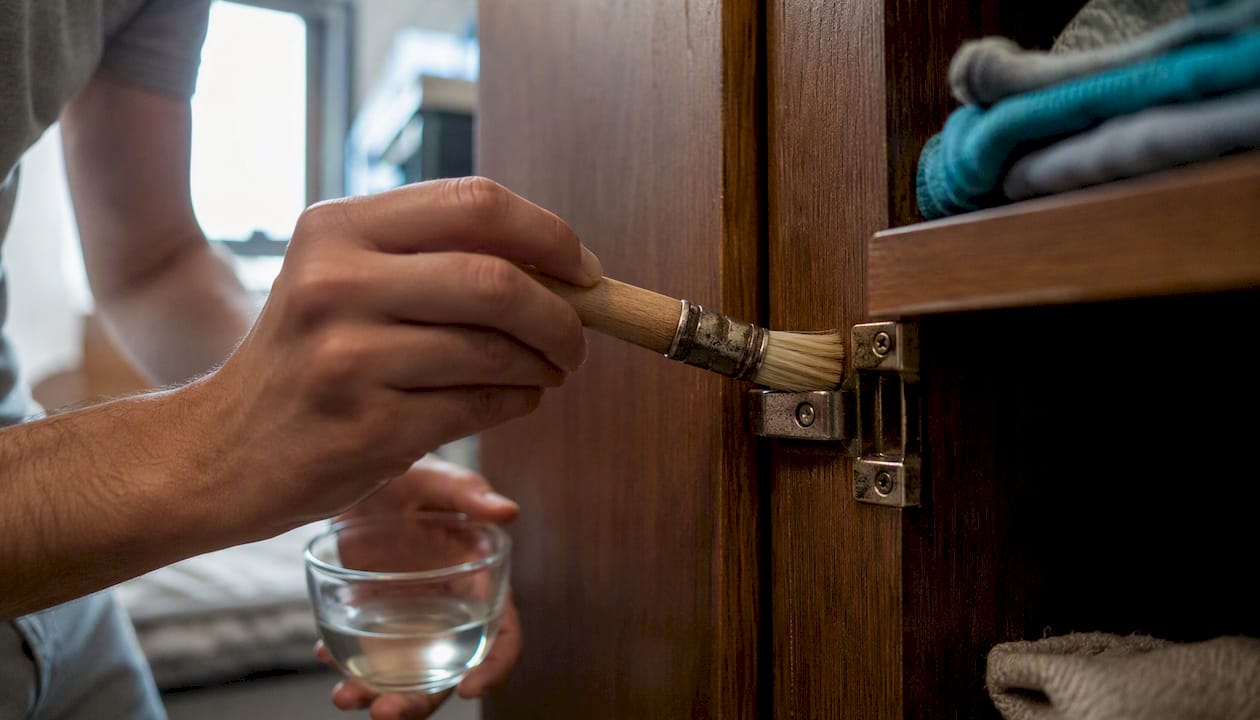
Professional tip: spores accumulate mainly in the grooves of hinges and in the joints between removable shelves. Use an old brush or a cotton swab dipped in the vinegar solution to reach these points before wiping down the general area. It's a step that most people skip and makes all the difference.
How to control humidity and prevent the smell from returning
Cleaning once is not enough if humidity continues to enter. Airing the wardrobe for 15 minutes a day and never storing damp clothes are the two most effective and most ignored measures.
Ventilation routine
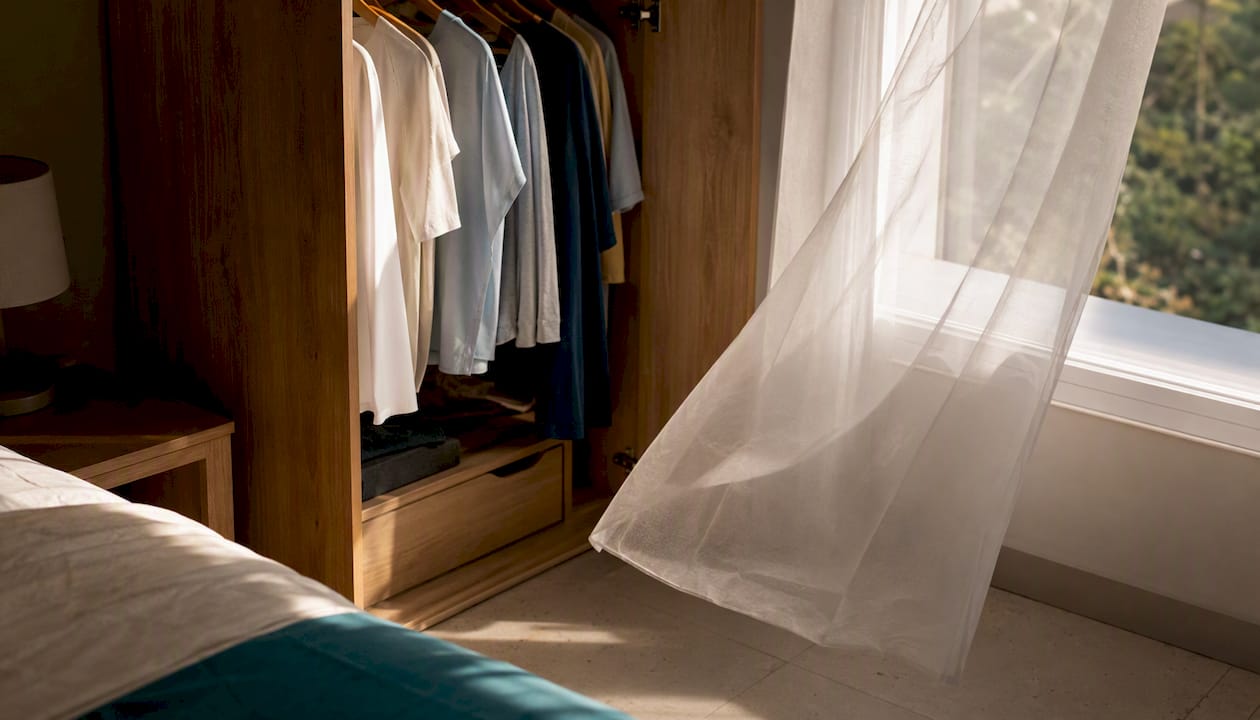
Open the wardrobe doors every morning while making the bed, for about 10–15 minutes. If the wardrobe is against an exterior wall (common in old Lisbon apartments), slightly pull it away from the wall to allow air circulation behind.
Passive vs. active solutions: what to choose
- Silica gel (packets): effective for low to moderate humidity; needs regeneration in the oven at 120 °C every 2 months.
- Calcium chloride (dehumidifier pots): visually shows the collected water and lasts between 30 to 90 days depending on ambient humidity. A good option for large wardrobes or very humid rooms.
- Activated charcoal: adsorbs odours and some humidity; regenerates in the sun for 2–3 hours. Silent and requires no chemical maintenance.
- Peltier electric dehumidifiers (mini): suitable for relative humidity above 60–70%, where passive solutions saturate quickly. They make some noise and consume energy, but are the most effective in persistent cases.
- Baking soda in open pots: neutralizes odours but has limited moisture absorption capacity; useful as a complement, not as the main solution.
In humid climates, combining regular ventilation with an active adsorbent (charcoal or calcium chloride) surpasses any fragrance. When relative humidity is high, mechanical solutions become necessary.
Professional tip: if the wardrobe is on a wall that condenses (cold in winter, humid in summer), the problem may be structural. Condensation on cold walls is one of the most common causes of persistent odours that return even after cleaning. In this case, no absorbent resolves it alone.
How to recover clothes with a musty smell
Clothes that have been inside the affected wardrobe need their own treatment; a normal wash is not enough.
- Separate the affected pieces and air them outdoors for 24–48 hours, preferably in the sun. UV radiation eliminates some surface fungi.
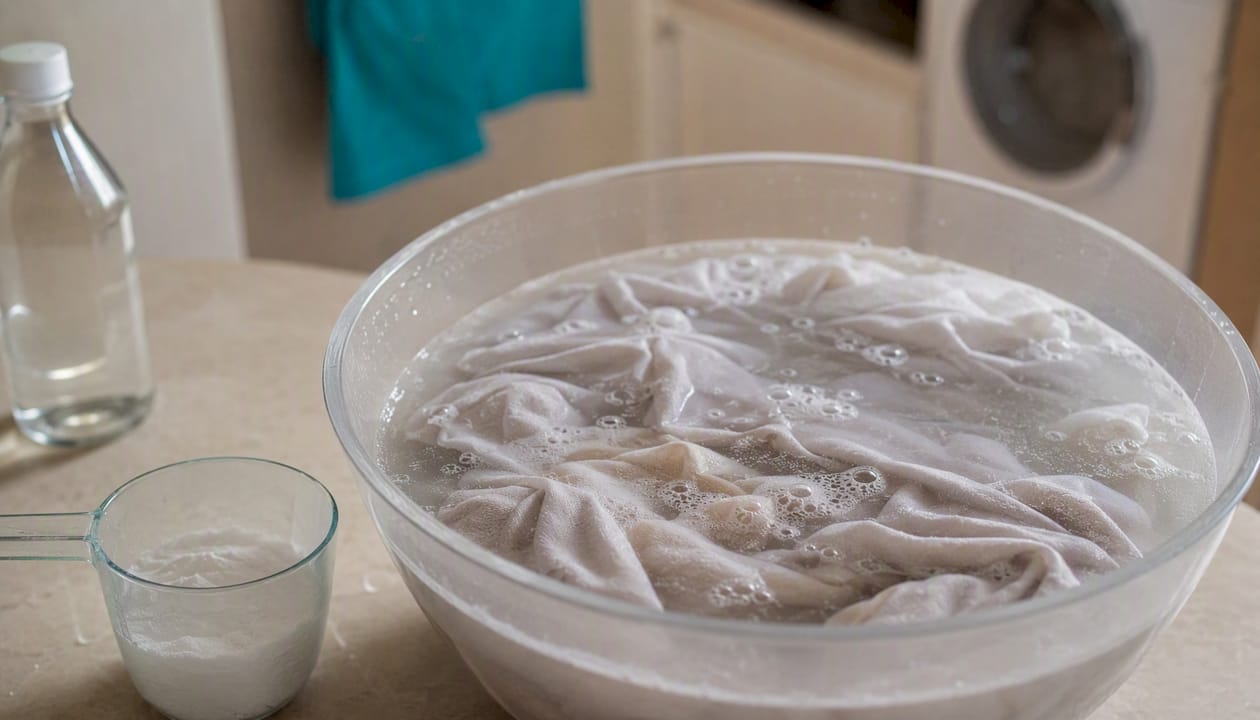
- Make a pre-soak for 30–60 minutes: dissolve 2 tablespoons of baking soda per litre of cold water. For heavily affected pieces, add 100 ml of white vinegar to the soaking water.
- Wash in the machine with the appropriate program for the fabric. Add 100 ml of white vinegar in the fabric softener compartment (not in the detergent). The vinegar evaporates during rinsing without leaving a smell.
- Dry completely before storing. Never store items with any residual moisture.
When to discard a piece: if the smell persists after two washes with treatment, or if there are dark mould stains that won't come out, the piece is compromised. Storing such a piece will contaminate the clean wardrobe again.
Home tricks that really work (and their limits)
Natural absorbents are maintenance allies, not solutions. Used after deep cleaning, they prolong the result.
- Activated charcoal: place 100–200 g in a permeable fabric bag (or an old sock) and leave it on a shelf. Regenerate in the sun every 4–6 weeks. It is the absorbent with the best effectiveness/cost ratio for medium to large wardrobes.
- Baking soda: neutralizes odorous compounds and works well in open pots. Change every 2–3 months. Place a small pot on each shelf.
- School chalk: absorbs some humidity and can help in small drawers, but is insufficient for an entire wardrobe. Useful as a spot complement.
- Lavender or cedar sachets: cedar has natural properties against moths and leaves a subtle aroma. Lavender is more aromatic than absorbent. Both work well as a complement but do not replace humidity control.
- Commercial neutralizers (like those from Humydry): treat odours in the environment and textiles when combined with humidity control measures. Useful when the smell persists after cleaning but there is no visible mould.
Avoid intense synthetic perfumes (air freshener sprays, scented tablets). They mask the odour without resolving it and may indicate that the underlying problem remains active.
When to use bleach and what safer alternatives exist
Bleach is effective against fungi, but context matters greatly.
Use bleach when:
- There are visible mould stains on non-porous surfaces (tiles, plastic, glass).
- The surface can withstand contact with chlorine without degrading.
Avoid bleach when:
- The surface is wood, laminate, or varnish — it discolours and damages the finish irreversibly.
- The fabrics are coloured or made of delicate fibers (wool, silk, synthetics).
How to use safely (suitable surfaces): dilute 1 part bleach in 10 parts water. Wear gloves, ventilate the room well, and always test in a hidden area. After application, rinse and dry completely. Never mix bleach with vinegar or ammonia.
Alternatives for wood and fabrics:
- Diluted white vinegar (1:1 with water) for wooden surfaces.
- 3% hydrogen peroxide for light non-porous surfaces, as a gentler alternative to bleach.
- Baking soda paste (baking soda + water) for spot stains on washable surfaces.
Note: hydrogen peroxide can bleach coloured surfaces. Always test before applying to visible areas.
When it's worth calling a cleaning professional
There are situations where home intervention is not enough, and recognizing them saves time and money.
Signs you need professional help:
- Mould stains that return weeks after cleaning.
- Persistent odour even after cleaning, airing, and using absorbents.
- Visible mould in an area larger than an A4 sheet inside or behind the wardrobe.
- Household members with aggravated respiratory symptoms (asthma, rhinitis) without apparent cause.
- Visible humidity on the wall behind the wardrobe or frequent condensation.
What a professional service should include:
- Inspection of the source of humidity (condensation, infiltration, or capillarity).
- Deep cleaning and disinfection of all internal surfaces.
- Mechanical drying of the interior and adjacent wall.
- Recommendation or execution of structural treatment if necessary.
- Report on the state of the space after intervention.
As for the cost, a deep domestic cleaning in Lisbon generally ranges from €80 to €200 depending on the size of the space and included extras. Structural anti-humidity treatments have separate and variable costs.
Professional tip: when scheduling a professional cleaning, explicitly ask them to include inspection of the wall behind the wardrobes and mechanical drying. Many basic services omit these steps, and they are precisely what prevent the recurrence of the problem.
How long it takes to resolve and how to maintain the result
Setting realistic expectations avoids frustrations.
- Immediate action (30–90 minutes per wardrobe): deep cleaning, placing absorbents, starting ventilation. The smell visibly reduces within the first 24 hours.
- Textile recovery (24–72 hours): includes airing, soaking, and washing. Heavily affected pieces may need two cycles.
- Cases with structural humidity (weeks to months): if the cause is condensation on the wall or infiltration, the smell returns while the underlying problem is not addressed. In these cases, cleaning is just the first step.
Maintenance plan:
- Weekly: do not store damp clothes; air the wardrobe for 10–15 minutes.
- Monthly: check the level of chemical dehumidifiers; air charcoal sachets in the sun.
- Quarterly: change the baking soda in pots; inspect corners and the back wall of the wardrobe; check seals of nearby windows.
Warning signs that the problem is not resolved: smell returning after 2–3 weeks, dehumidifiers saturating in less than 2 weeks, or new dark stains in corners that had been cleaned.
What I learned about solving odours in damp houses
There is a tendency to go straight for products, whether a scented spray, a lavender sachet, or an expensive electric dehumidifier, before understanding what is really happening. The problem is that the musty smell in a wardrobe is a symptom, not the cause. Treating the symptom without understanding where the humidity comes from is like drying the floor with the tap open.
My preference is for low-impact solutions: consistent ventilation, activated charcoal, and white vinegar resolve most cases without aggressive products and without significant costs. They are also more sustainable than repeated cycles of chemicals.
That said, there are cases where the scale for professional intervention is the most rational decision. When humidity comes from the building structure, such as condensation on cold walls or lateral infiltrations, no home solution is permanent. Recognizing that limit early saves months of failed attempts.
What surprises me most is how many people continue to store slightly damp clothes out of habit. It is the easiest step to change and has the most immediate impact. Before buying any product, check that point.
Cleaning Point handles persistent odours that don't yield to DIY
When home cleaning is not enough, Cleaning Point offers a concrete alternative: a deep cleaning performed by professionals in Lisbon, including inspection of the source of humidity, disinfection of internal surfaces, and mechanical drying.

The practical difference compared to routine cleaning is the detailed checklist that the team follows: each wardrobe, corner, and adjacent wall is inspected, not just superficially cleaned. For those with a wardrobe that has a persistent odour that returned after several attempts, or visible mould that won't come out with vinegar, this is the next most direct step.
To schedule an assessment or find out what is included, book your cleaning directly on the website.
Sources
- Tips to eliminate the musty smell from clothes and home | idealista
- Humidity and musty smell? Just need chalk sticks to save wardrobes | IOL
- Experts in anti-humidity treatments | Murprotec
- Musty smell in the wardrobe: causes and lasting solutions | Speed Queen
Frequently asked questions
How to quickly remove musty smell from the wardrobe?
Empty the wardrobe, clean all surfaces with a solution of white vinegar and water (1:1), dry completely, and place an activated charcoal or calcium chloride absorbent. The smell reduces within the first 24 hours.
How to effectively remove humidity from the wardrobe?
Air the wardrobe for 10–15 minutes a day and use calcium chloride dehumidifiers, which visually show the collected water and last 30–90 days.
How to clean the interior of a wardrobe without damaging the wood?
Use a diluted white vinegar solution in water (1:1), test first in a hidden area, and apply with a damp cloth, never soaked, following our best tips for cleaning interior doors. Avoid bleach on varnished wood, as it permanently damages the finish.
What to do when the musty smell in clothes doesn't come out in a normal wash?
Make a pre-soak for 30–60 minutes with 2 tablespoons of baking soda per litre of water, then wash with 100 ml of white vinegar in the fabric softener compartment. If the smell persists after two washes with this treatment, the piece should be discarded.
When should I call a professional to treat the smell in the wardrobe?
Call a professional when mould returns after cleaning, when there is visible humidity on the wall behind the wardrobe, or when respiratory symptoms of those living in the house worsen. Cleaning Point offers deep cleaning with humidity inspection in Lisbon.


