How to clean a cooker hood: practical steps and maintenance
In summary:
- To clean a domestic cooker hood, you should turn off the appliance, remove the filters, and soak them in hot water with degreaser. It is recommended to clean the exterior surface weekly and the metal filters every 3–4 weeks, replacing charcoal filters every 3–6 months. Effective cleaning involves materials such as gloves, cloths, soft brushes, and neutral or natural products, avoiding abrasives or strong chemicals.
To clean a domestic cooker hood right now: turn off the power, remove the filters, and soak them in hot water with degreaser for 20–30 minutes. While the filters are soaking, clean the exterior with a damp microfiber cloth. Before starting anything, never forget to unplug the appliance — accumulated grease is flammable, and any contact with wet electrical components can cause a short circuit.
The three essential steps to get started:
- Turn off the power and, if possible, unplug it.
- Remove the filters carefully and soak them in a basin with hot water and degreasing detergent.
- Clean the exterior with a damp cloth, avoiding spraying any product directly onto the control panel.
Professional tip: A clogged filter not only reduces extraction but also overloads the motor and increases the risk of fire. Regular cleaning is a matter of safety, not just hygiene.
Index
- How often should you clean each part of the cooker hood?
- What you need for effective cleaning
- Step by step: how to clean the cooker hood at home
- Metal filters: dishwasher or manual cleaning?
- Activated charcoal filters: when to replace and how to regenerate
- Motor and ducts: when is it really necessary to call a technician?
- What to do when the cooker hood has persistent problems
- Key takeaways
- When it makes sense to hire a professional service
- Useful sources and manufacturer manuals
- Frequently asked questions
How often should you clean each part of the cooker hood?
The right frequency depends on kitchen usage, but there is a reference base that works for most homes. According to the Teka Portugal guide, the recommendations are:
- Exterior: weekly, to prevent grease from solidifying.
- Metal filters: wash every 3–4 weeks, in the dishwasher or by soaking in hot water.
- Activated charcoal filters: replace every 3–6 months; long-lasting ones can be regenerated up to 5–8 cycles, according to the manufacturer.
- Motor and ducts: inspection and deep cleaning by a technician at intervals recommended by the manufacturer.
Those who cook little can stretch these intervals; those who fry frequently should shorten them. Cleaning grease while it is still warm is much easier than tackling a solidified layer weeks later — prevention is always the most effective intervention.
Professional tip: Leave the cooker hood running for 3–5 minutes after finishing cooking. It eliminates residual steam and reduces the amount of grease that settles on the filters.

What you need for effective cleaning
Before you start, gather your materials. Having everything on hand avoids interruptions during the process.
Essential materials:
- Rubber gloves
- Microfiber cloths (at least two: one damp, one dry)
- Non-abrasive sponge
- Soft bristle brush (an old toothbrush works for corners)
- Large basin or tub
- Neutral degreasing detergent
- Baking soda and white vinegar (natural alternatives)
Natural vs. chemical — when to use each:
Natural methods (vinegar diluted in water, baking soda paste) work well for regular maintenance and fresh grease. For hardened and ingrained grease, an enzymatic degreaser or one with APG surfactants is more effective and saves effort. Avoid very acidic or strong alkaline products on aluminum surfaces — they can corrode the mesh of the filters.
What to never do:
- Steel sponges or abrasive materials that scratch stainless steel and aluminum.
- Spray products directly onto the control panel or electrical components.
- Use bleach on metal filters — it damages the coating.
For stainless steel surfaces, always clean in the direction of the grain of the metal, with a specific product for stainless steel, to preserve the finish and avoid scratches.
Step by step: how to clean the cooker hood at home
This procedure covers complete cleaning, from preparation to final assembly.
- Turn off the appliance from the power supply. It’s not enough to just turn off the button — unplug it or cut the corresponding circuit breaker.
- Protect the work surface with a cloth or newspaper under the cooker hood, to catch grease drips.
- Remove the metal filters with a gentle motion (most fit by pressure or have a release tab).
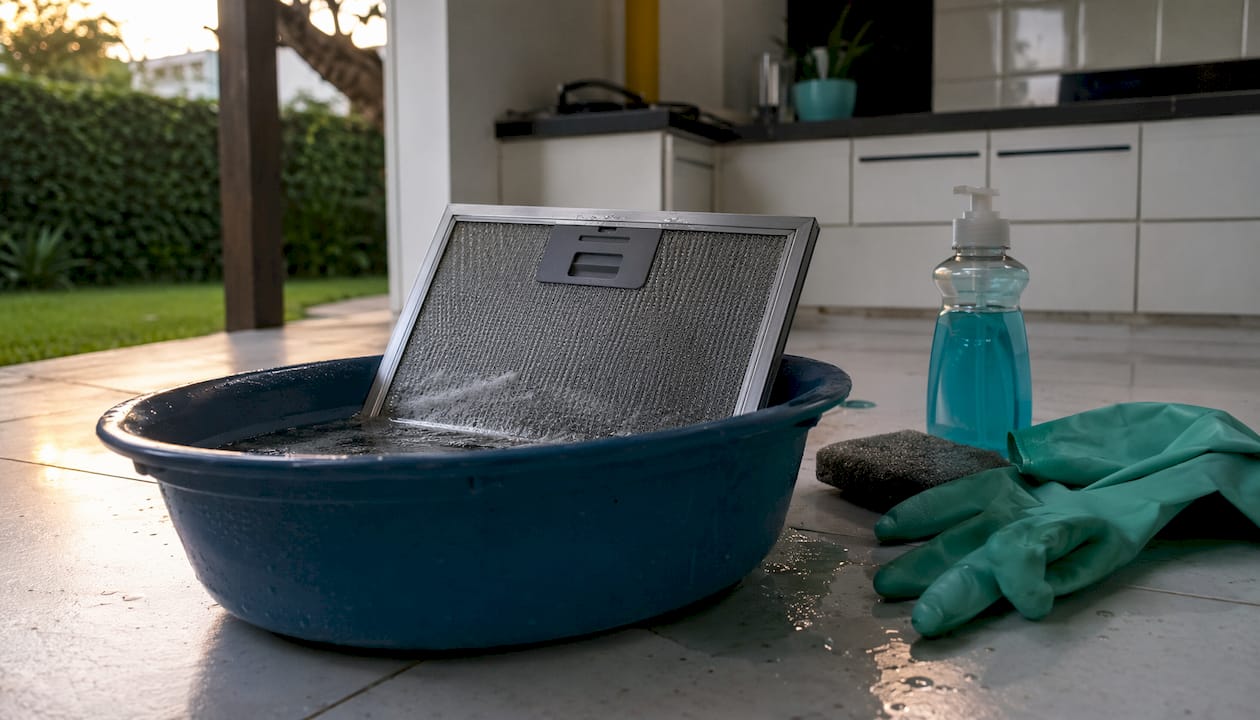
- Soak the filters in a basin with very hot water and degreasing detergent. Let them soak for 20–30 minutes. For very hardened grease, add two tablespoons of baking soda.
- Clean the accessible interior of the cooker hood with a slightly damp cloth, wiping the grease collection tray. Never let water drip into the motor.
- Clean the exterior: damp cloth with neutral detergent, then dry cloth. On stainless steel, always wipe in the direction of the grain.
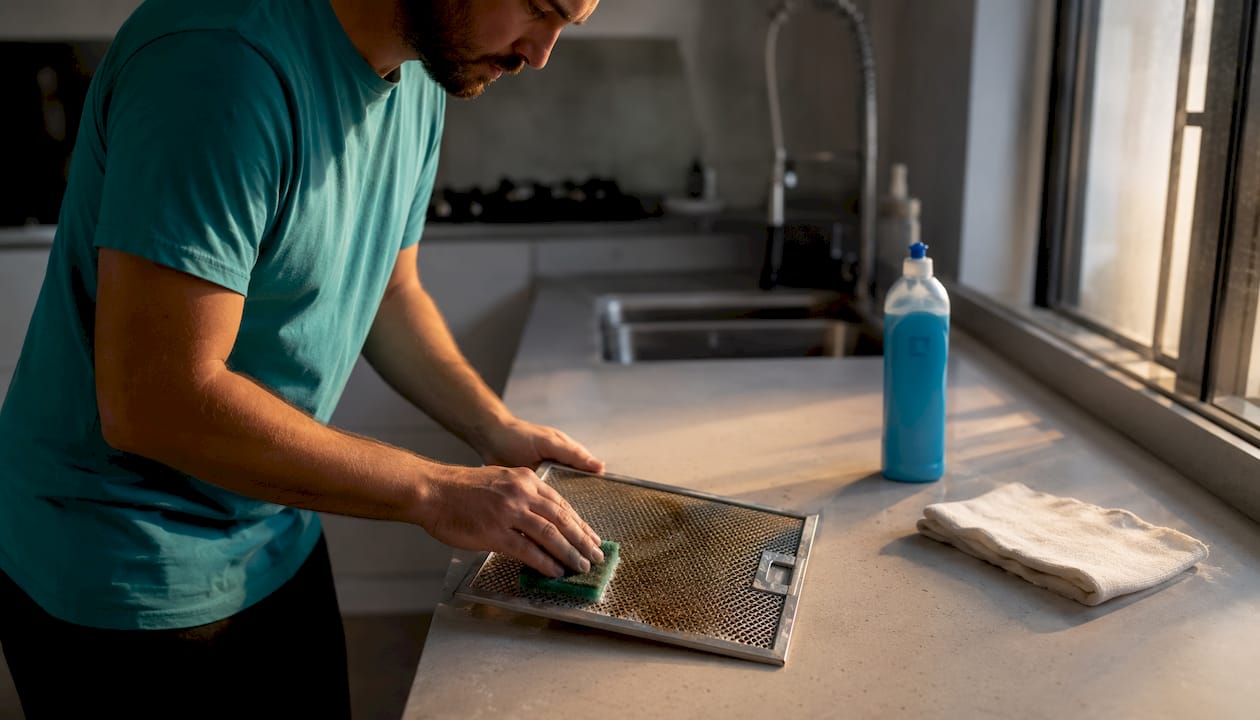
- Scrub the filters with a soft bristle brush, rinse well with running water, and let them air dry completely.
- Reassemble everything only when the filters are completely dry — reinstalling damp filters encourages the growth of mold and bad odors.
- Turn on the appliance and test for 1–2 minutes to confirm it is working normally.
Professional tip: For very ingrained grease, heat the water in the basin as much as possible (almost boiling) and add a bit of dishwasher detergent. The high temperature dissolves the grease without additional effort.
Metal filters: dishwasher or manual cleaning?
Both methods work. The choice depends on the level of dirt and the type of filter.
Washing in the dishwasher
- Check in the manufacturer’s manual if the filters are dishwasher compatible.
- Place the filters in a vertical or tilted position, never lying down blocking the spray arm.
- Use an intensive program at high temperature (60–70 °C).
- Avoid tablets with bleaching agents — they can discolor aluminum.
- Remove the filters and let them dry completely before reassembling.
Manual cleaning by soaking
- Fill a basin with very hot water and degreasing detergent.
- Soak the filters and wait 20–30 minutes.
- Gently scrub with a soft bristle brush, paying attention to the meshes.
- Rinse with hot running water and air dry.
When to replace a metal filter: if it shows deformation, torn mesh, or visible damage that does not disappear with cleaning, replacement is the only solution. A damaged filter does not filter correctly and may allow particles to pass into the motor.
Activated charcoal filters: when to replace and how to regenerate
Most activated charcoal filters are not washable and must be replaced. Trying to wash them with water and detergent destroys the porous structure that absorbs odors. Electrolux recommends replacing standard filters approximately every 4 months.
However, there is one exception: long-lasting charcoal filters, found in some models (such as certain IKEA hoods), which allow regeneration. The procedure, when authorized by the manufacturer:
- Wash the filter in the dishwasher at 70 °C, without detergent.
- Dry in the oven at 70 °C for 2 hours.
- Limit the number of regenerations to that indicated by the manufacturer (typically 5–8 cycles).
Professional tip: Before buying a replacement filter, note the PNC (product number) of your cooker hood — it’s on the label inside the appliance. This ensures you buy the exact filter and avoids incompatibilities.
Signs that the charcoal filter is saturated: kitchen odors are no longer absorbed and start to spread throughout the house even with the hood on. At that point, replacement cannot wait.
Motor and ducts: when is it really necessary to call a technician?
The motor and internal ducts are beyond the reach of safe domestic cleaning. It’s not a matter of capability — it’s a matter of risk. According to the professional protocols of Instaquim, duct cleaning in professional contexts should be done monthly by a specialized company; in residences, the recommended interval is semi-annual or annual, depending on usage.
Signs that indicate you need a technician:
- Burning smell during operation.
- Unusual noises (vibration, creaking, rhythmic banging).
- Significant loss of extraction power, even with clean filters.
- Visible sparks or repeated tripping of the circuit breaker.
Professional tip: Never use direct steam or pressurized water on the motor or any electrical component of the cooker hood. The risk of short circuit and corrosion is real — and it can void the appliance’s warranty.
For situations of extreme accumulation or when specialized professional cleaning services are needed, the intervention of certified technicians is the only safe option.
What to do when the cooker hood has persistent problems
Weak airflow or blockage: start by checking and cleaning the filters. If the problem persists with clean filters, the blockage may be in the ducts — that’s technician territory.
Bad smells: the most common cause is a saturated charcoal filter. Replace it. If the smell persists, clean the grease collection tray and sprinkle dry baking soda on the accessible internal surfaces, letting it sit for 15 minutes before cleaning.
Strange noises:
- Vibration or banging: check if the filters are properly fitted and if there are loose screws in the external grilles.
- Continuous creaking: may indicate grease accumulation on the motor blades. Turn off the appliance and contact technical support.
Any problem that persists after cleaning all accessible points is a sign to escalate. Trying to force a repair on the motor without proper training is the quickest way to irreversible damage.
Key takeaways
Regularly cleaning the cooker hood protects the motor, reduces the risk of fire, and keeps the kitchen smelling fresh — and the routine is simpler than it seems.
| Point | Details |
|---|---|
| Exterior frequency | Clean the external surface weekly to prevent grease from solidifying. |
| Metal filters | Wash every 3–4 weeks, in the dishwasher or by soaking in hot water. |
| Charcoal filters | Replace every 3–6 months; long-lasting ones can be regenerated up to 5–8 cycles. |
| Motor and ducts | Call a technician every 6–12 months or when a burning smell, noise, or loss of power occurs. |
| Cleaning Point | For deep cleans in Lisbon, Cleaning Point offers service with a detailed checklist and certified team. |
What experience teaches us about cooker hood maintenance
Most people only think about the cooker hood when it starts to fail. And when that happens, the problem is rarely just the filter — it’s months of accumulated grease that has entered the motor, ducts, and blades. The cost of a repair or replacement is always much higher than that of regular maintenance.
There’s another aspect that generic guides rarely mention: safety. A cooker hood with saturated filters is not only inefficient — it’s a real fire risk. Accumulated grease is fuel. Maintaining a cleaning routine is not domestic perfectionism; it’s a basic safety measure.
What I recommend is simple: treat the cooker hood as you would any other critical appliance. Give it regular attention, know how to recognize signs of malfunction, and don’t hesitate to call a professional when the problem is beyond what a cloth and degreaser can solve.
When it makes sense to hire a professional service
There are situations where domestic cleaning is not enough: extreme grease accumulation in the ducts, motors with persistent noises, or simply a lack of time to maintain a consistent routine. In these cases, a professional service is not a luxury — it’s the most efficient choice.

Cleaning Point offers deep cleaning in Lisbon with a detailed checklist, consistent team, and digital report after each visit. It covers appliances, including cooker hoods, ovens, and refrigerators, with products suitable for each surface. There are no mandatory contracts: you can start with a one-off deep clean and decide later if you want recurring maintenance.
Before hiring any service, ask: what certifications do they have? Do they use safe products for stainless steel and aluminum surfaces? Do they provide a record of the work done? Cleaning Point answers all these questions transparently. To see what is included in each visit, check the detailed checklist or book a cleaning directly.
Useful sources and manufacturer manuals
- Teka Portugal Guide: recommended frequencies by component, safety warnings, and motor cleaning instructions.
- Electrolux Portugal Support: regeneration procedure for long-lasting charcoal filters and cycle limits.
- Zanussi Portugal Support: care for stainless steel surfaces and cleaning technique in the direction of the grain.
- Instaquim: professional cleaning protocols for ducts and motors, with frequencies and HACCP documentation.
- VortexMag: practical guide for grease filters and the relationship between clogged filters and fire risk.
Frequently asked questions
How do you clean the inside of the cooker hood?
With the appliance unplugged, wipe a slightly damp cloth with degreaser on the accessible internal surfaces, including the grease collection tray. Never let water enter the motor or electrical components.
How to clean the motor of a cooker hood?
Deep cleaning of the motor should be done by a certified technician. At home, the safest maximum is to clean the accessible external surfaces with a dry or slightly damp cloth, always with the appliance unplugged.
How to unclog a cooker hood with weak airflow?
Start by removing and cleaning the metal filters — the most common cause of reduced airflow is a saturated filter. If the problem persists after cleaning the filters, the blockage may be in the ducts and requires technical intervention.
How to clean the chimney or duct of the cooker hood?
Internal cleaning of the ducts is not safe to do at home without proper equipment. Contact a specialized company that has the right tools and products to remove accumulated grease without damaging the ducts.
How often should I replace charcoal filters?
Standard charcoal filters should be replaced every 3–6 months, depending on the manufacturer and usage intensity. Long-lasting filters can be regenerated, but they have a cycle limit (typically 5–8) indicated by the manufacturer.