How to clean window tracks without damaging them

Clean the track as follows: vacuum to remove loose debris, scrub with warm water and mild detergent, treat crusts with vinegar and baking soda (wait 5 to 10 minutes), and once dry, apply dry silicone or powdered graphite. The complete process takes between 15 and 30 minutes per window. Avoid household oils and dry thoroughly before lubricating.
In summary:
- Cleaning window tracks requires proper preparation, removing loose debris with a vacuum before applying chemical or mechanical solutions.
- Using vinegar and baking soda removes stubborn crusts, but it is essential to rinse well to avoid corrosion on aluminum profiles.
- Appropriate products like dry silicone or powdered graphite ensure effective lubrication, preventing dust clumps and premature wear.
- Regular maintenance, with annual inspections and cleanings every two to three months, helps prevent dust accumulation and structural damage.
- When home cleaning does not resolve jamming or advanced corrosion issues, hiring specialized professionals is the best option.
Index
- Materials and tools for cleaning window tracks
- Step by step: how to clean window tracks without creating mud
- Quick tricks that help but do not replace deep cleaning
- Lubrication: what to use and what to avoid
- How often to clean and when to ask for help
- When to hire professionals: the Cleaning Point approach
- Practical perspective on cleaning tracks
- Schedule a professional cleaning with Cleaning Point
- Sources
- Frequently asked questions
Materials and tools for cleaning window tracks
You do not need specialized products to do this job well. Most of what you will use is already in your kitchen or cleaning cupboard.
To remove loose dirt, a vacuum with a narrow nozzle and an old toothbrush will solve almost everything. Microfiber cloths and cotton swabs reach corners where the brush cannot, and are particularly useful in the narrow grooves of aluminum frames.
For the actual cleaning, you need:
- Vacuum with brush nozzle or narrow tip
- Old toothbrush or soft bristle brush
- Microfiber cloths and cotton swabs for corners
- Mild detergent (dish soap works well)
- White vinegar and baking soda for tougher crusts
- Protective gloves, especially if using vinegar in quantity
- A stable stepladder if the windows are high
- A small container to prepare mixtures
The mild detergent handles everyday dirt. The vinegar with baking soda comes into play when there is accumulated grease, slight mold, or compacted dust crusts that resist warm water alone.
For the final step, keep dry silicone spray or powdered graphite on hand. Never use cooking oils, petroleum jelly, or common spray lubricants on the tracks: they are sticky and attract more dust than they solve, as explained by technical lubricant manufacturers for doors and windows.
Step by step: how to clean window tracks without creating mud
This is the method that avoids the most common mistake: turning dry dust into thick mud that clogs the track even more.
Prepare the workspace
Open the window fully and protect the floor or countertop with an old cloth or newspaper. If the window opens inward, be extra careful with splashes on nearby curtains or blinds.
The seven steps that work
- Remove loose debris first. Put on gloves and manually remove leaves, dirt, and hair. Then vacuum immediately with the narrow nozzle, covering the entire length of the track. This step is the most ignored and the most important: wetting dry dirt without vacuuming first is why so many people end up with a dark paste that is difficult to remove.
- Prepare the warm water and detergent mixture. A small container with warm water and a few drops of mild detergent is enough. Wet the toothbrush or a thin cloth and scrub along the groove, using short movements.
- Work the grooves with fine tools. Damp cotton swabs reach corners and points where the track meets the frame, where more compacted dust tends to accumulate.
- For stubborn crusts, use vinegar and baking soda. Sprinkle baking soda over the affected area and drizzle with white vinegar. The fizzing reaction loosens embedded dirt and mold without attacking the finish of the profile.
- Let it sit for 5 to 10 minutes. Do not rush this phase. It is the time the mixture needs to soften deposits that water alone would not resolve.
- Remove the resulting paste with a cloth or brush. The dirt comes off relatively easily after the waiting time. Insist slightly on the corners.
- Rinse and dry completely. Wipe with a clean damp cloth to remove residues of vinegar and baking soda, then dry thoroughly with a dry cloth or paper towel. Only after the track is dry inside should you proceed to lubrication.
Professional tip: Never apply vinegar to aluminum profiles without rinsing afterward. The acidic residue can accelerate metal corrosion over time, especially if not removed immediately.
After drying, test the window by opening and closing it. If you still feel resistance, the problem may not be dirt, but a lack of lubrication, which we will address next.
Quick tricks that help, but do not replace deep cleaning
Cleaning videos full of "foolproof tricks" are not wrong, just incomplete. They work well for recent dirt, but not for old accumulation.
- Damp kitchen paper folded into a wedge: slides along the track and absorbs light dust and cobwebs in seconds, ideal for a quick clean between deeper cleans.
- Narrow vacuum nozzle directly in the groove: works best when moved slowly, rather than a quick back-and-forth motion.
- Old toothbrush in corners and visible rollers: reaches areas where cloths and cotton swabs do not fit.
- Pressure water only outside: a gentle hose can help unclog outdoor drainage from gutters, but should never be used on interior tracks, where excess water gets trapped and encourages mold.
These tricks are great for everyday maintenance. Against grease crusts, established mold, or compacted dust for months, they are just a complement to the vinegar and baking soda technique, not a substitute for it.
Lubrication: what to use and what to avoid
A clean but poorly lubricated track will still jam, and this is where many people make the mistake that nullifies all previous work.
The right choice is dry silicone spray or powdered graphite. Both create a thin layer that reduces friction without becoming sticky. Apply in small amounts, directly into the groove where the wheel or pin of the frame moves, and remove excess with a microfiber cloth.
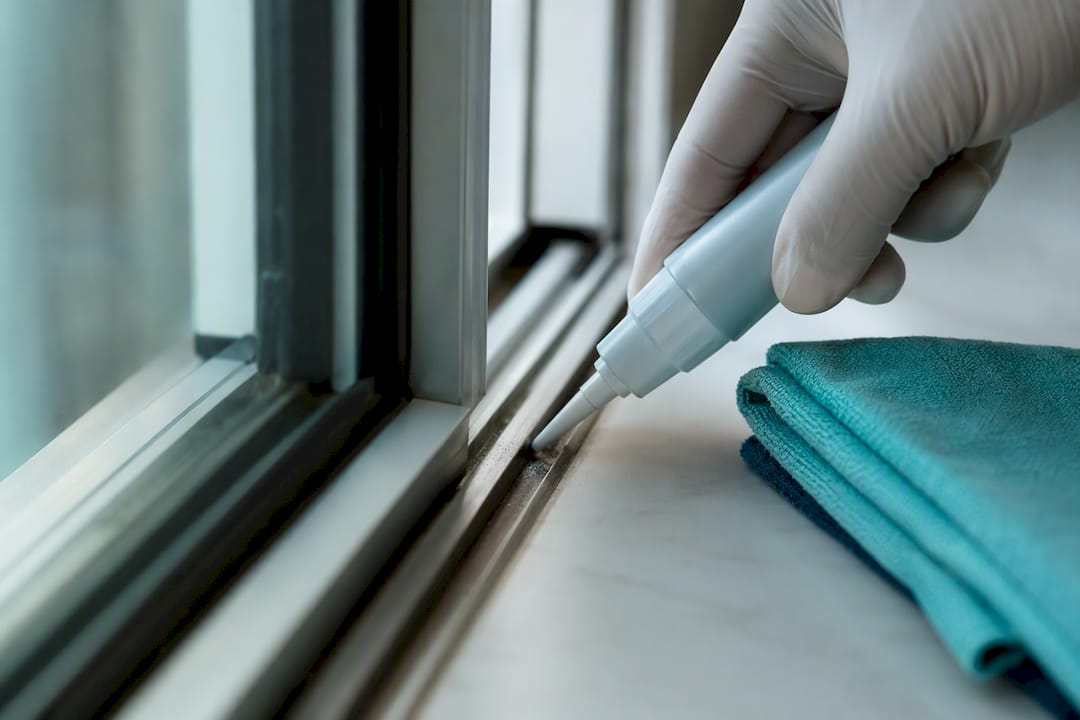
Avoid cooking oils, petroleum jelly, common WD40, or any generic lubricant spray designed for metal hinges altogether. These products become viscous over time and turn into a magnet for dust and sand, forming an abrasive paste that wears down the track faster than a lack of lubrication.
Professional tip: Apply the lubricant only after the track is completely dry. If applied over residual moisture, the product will not adhere well and will lose its effect in a few days.
If, even after cleaning and lubricating, the frame continues to jam or make noise, the problem is likely not dirt. Broken rollers or deformed wheels require mechanical replacement, not lubrication, and in that case, it is better to call someone with the proper tools than to insist on more product.
How often to clean and when to ask for help

A simple routine prevents the work from becoming burdensome. Do light cleaning (vacuuming and wiping) every month, a complete cleaning with vinegar and baking soda every 2 to 3 months, and a more thorough inspection once a year, checking hardware and seals.
During that annual inspection, confirm:
- If the window slides effortlessly along the entire length of the track
- If there are signs of corrosion or persistent moisture stains
- If the rubber seals remain flexible and are not tearing
- If there is visible water infiltration in the lower corner of the frame
Jamming that does not disappear after cleaning and lubricating, visible corrosion on the metal, or water entering even with the window closed are signs that the problem can no longer be resolved with household products.
When to hire professionals: the Cleaning Point approach
There are situations where it is better to delegate than to spend an afternoon scrubbing tracks. After construction, when construction dust is spread throughout the house, or when mold appears in hard-to-reach areas, light home cleaning is not enough.
Cleaning Point works with detailed checklists by room, fixed teams whenever possible, and a digital report at the end of each visit, providing predictability for those who do not want surprises. For those with little time or windows in hard-to-reach areas, this type of service handles the cleaning of windows, gutters, and tracks as part of a broader process, without random third parties entering the home.
Practical perspective on cleaning tracks
Most of the mistakes I see on this topic are not technical, but priority: people clean when the track is already jamming, not before. In Portugal, with fine road dust and, in coastal areas, saline deposits that accelerate aluminum corrosion, waiting months between cleanings is what turns a ten-minute task into a battle of crusts. Prevention is always worth more than remedying.
— Taras
Schedule a professional cleaning with Cleaning Point
If you have already cleaned the track and the window continues to jam, or simply do not have time to dedicate an afternoon to this task, Cleaning Point is the alternative to doing everything yourself in Lisbon: a trained team handles the cleaning of windows, gutters, and tracks with its own checklist, without needing to buy products or test techniques.

The service fits particularly well after construction, when construction dust accumulates in every corner, or in deep cleans that cover the entire house, including areas we rarely clean, like tracks and high frames. For those preparing a home for new tenants, the move-in and move-out cleaning takes care of these details without needing to supervise every step. You can check the available services and schedule a cleaning directly online.
Sources
For those who want to delve deeper into the topic, the PVC window maintenance guide details inspection frequencies, and the article on aluminum gutters explains the complete sequence for outdoor drainage. Those who prefer to organize cleaning by areas before starting can check these cleaning tips for attics and accumulation areas.
- DIY cleaning: how to clean window frames in 12 steps
- PVC window maintenance
- Professional 3-in-1 lubricant for doors and windows
- How to clean windows: complete guide
Frequently asked questions
How to clean window frames?
Start by vacuuming loose dust, then scrub with a cloth and warm water with mild detergent. For tougher stains, apply vinegar with baking soda and let it sit for 5 to 10 minutes before removing with a cloth.
How to clean window gutters?
First, remove leaves and debris by hand, then vacuum with a narrow nozzle to reach the corners. Treat persistent crusts with vinegar and baking soda and, outside, wash with a gentle hose to ensure good drainage.
How long does it take to clean a window track?
A complete cleaning, from vacuuming to final lubrication, takes between 15 and 30 minutes per window. Windows with old crusts or more grooves may take a little longer.
What product to use to lubricate the track after cleaning?
Use dry silicone spray or powdered graphite, which do not attract dust. Avoid cooking oils or viscous lubricants, which create an abrasive paste that wears down the mechanism.
How much does it cost to hire Cleaning Point to clean windows?
You can check updated prices and request a quote directly on Cleaning Point's services page.