Cleaning Instructions: How to Prepare Your Home in Lisbon

For effective professional cleaning in Lisbon, clear surfaces, ensure access, and communicate two or three clear priorities. The rest is up to the team. Those who prefer to delegate all logistics can rely on a professional company that follows checklists and confirms licensing and civil liability insurance. Keep chemicals out of reach of children and pets before the team arrives.
In summary:
- For efficient cleaning, prepare surfaces, remove loose items, and communicate priorities to the team before the visit.
- Facilitated access and clear communication about schedules, products to avoid, and who provides materials prevent delays and increase service effectiveness.
- Ensuring the safety of children and pets involves storing chemicals out of reach, supervising, and using products compatible with surfaces.
- A quick inspection at the end of the cleaning helps avoid misunderstandings, report damages, and schedule the next maintenance cycles.
- Advance preparation and the use of detailed checklists reduce costs and intervention time, promoting quality and consistent cleaning.
Index
- Practical Checklist by Room Before Cleaning
- Before the Visit: Access, Schedules, and Communication
- What to Expect During the Intervention
- Home Safety: Children, Pets, and Cleaning Products
- After Cleaning: Inspection, Feedback, and Reporting Issues
- Cleaning Point's Perspective on Good Preparation
- How to Schedule a Cleaning with Cleaning Point
- Sources
- Frequently Asked Questions
Practical Checklist by Room Before Cleaning
Good cleaning instructions start the day before, not the next morning. Industry guides recommend preparing the home in advance and leaving countertops and tables clear, so the professional can dedicate the contracted time to cleaning itself and not to prior tidying up, as explained by Donamaid. It makes sense: every minute spent removing clothes from the sofa is a minute not spent disinfecting the bathroom.
Organize preparation by rooms:
- Living Room: remove loose items, blankets, toys, and newspapers; clear tables and support surfaces.
- Kitchen: store open food, partially empty the sink, and notify about sensitive appliances (pyrolytic oven, coffee machine with removable parts).
- Bedrooms: collect clothes from the floor and separate the bedding that needs to be changed; signal fragile or valuable items.
- Bathrooms: store cosmetics and personal hygiene products; separate towels you want washed from those that stay in place.
- Service Areas and Balconies: remove debris or accumulated trash bags; confirm access to outlets and running water.
- Areas Under Renovation or Recent Work: identify surfaces still curing, such as fresh paint or baseboard adhesives.
The time required varies with the type of property and the service requested. As a guideline: duration varies depending on the type and condition of the property; smaller properties under regular maintenance tend to require less time, while post-construction cleanings or move-in/move-out cleanings may demand more hours. These numbers serve only as planning references, never as fixed guarantees.
If the intervention is post-construction, there is an extra step: confirm that the work is fully completed and remove heavy debris before the team arrives, ensuring energy and water are available for industrial vacuums, as recommended by the Grupo Limpeza. To protect freshly painted walls and baseboards during preparation, it is advisable to consult specific guidelines on how to prepare the home for painting and plastering work.
Before the Visit: Access, Schedules, and Communication
Poorly handled logistics are the main cause of delays. Properly preparing access, whether through a doorman, code, or master key, prevents the team from wasting contracted time just trying to get into the house, according to Donamaid.
Before the scheduled day, resolve these points:
- Confirm the exact time and establish a direct contact method, plus an alternative contact for unforeseen events.
- Agree on the access method (key, code, doorman) and notify the reception in advance, if applicable.
- Specify products to avoid (e.g., bleach on marble surfaces) and sensitive materials, such as solid wood or leather.
- Define who provides the products and equipment: the professional team or the client themselves.
- If you cannot be present, leave visible written instructions or a formal authorization for entry.
Professional companies value clients who summarize priorities in a few lines. A short list with two or three priorities increases the actual effectiveness of the visit more than an extensive and generic list, according to Donamaid.
What to Expect During the Intervention
An experienced team follows a logical sequence: usually from dry to wet, starting with dusting and collecting items, before moving on to vacuuming, surface washing, and finally, bathrooms and kitchen. The priorities agreed upon in advance are addressed first in the work order.
During the visit, it is normal for the team to use physical or digital checklists to track progress and mark completed or pending tasks. If you need to communicate something during the cleaning, avoid interrupting directly:
- Leave a visible note in an agreed location (e.g., on the kitchen counter).
- Use a message via SMS or messaging app if you are out of the house.
- Reserve in-person conversations for the beginning and end of the visit, not for the middle.
Some specific tasks, such as deep cleaning upholstery with old stains or treating mold on baseboards, may require an additional visit with specialized equipment.
Professional Tip: keep the two or three priorities of the visit in writing, even if you also mention them verbally. A physical note won't get lost in shift changes or depend on mobile network.
Home Safety: Children, Pets, and Cleaning Products
Safety during the intervention is not a minor detail. The recommendations from the CNPDPCJ on child safety include storing chemicals out of reach, protecting electrical outlets, and maintaining active supervision over small children in the house.
Applied to professional cleaning, this means:
- Store medications and cleaning products in high or locked cabinets before the team arrives.
- Supervise or keep small children away from areas where products with ammonia, bleach, or strong degreasers are used.
- Create a safe and separate space for pets, especially during vacuuming, which often scares more sensitive dogs and cats.
- Confirm that the products used are compatible with the home's surfaces, as producers and distributors in Portugal are required to provide usage instructions and risk information, with oversight from the DGC and ASAE, according to the Gov.
None of these measures are optional when there are small children or pets in the house: they always apply, regardless of who is doing the cleaning.
After Cleaning: Inspection, Feedback, and Reporting Issues
Once the visit is over, a quick inspection avoids misunderstandings and allows for adjustments on the spot.
- Conduct an inspection of about five minutes with the team, following the final checklist agreed upon at the beginning, as recommended by Donamaid.
- If you notice any damage, document it with photographs and communicate it to the company within the timeframe agreed upon in the contract or quote.
- Request proof of licensing and civil liability insurance if you have not yet received it, and keep that communication in writing. Recommended industry practices indicate this request as a healthy sign of client care, not distrust, according to Supervivo.
- Define the next cycle: bi-weekly or weekly maintenance for homes with heavy use, and a deep cleaning every three or four months, or after events such as renovations, moves, or short-term rentals.
Cleaning Point's Perspective on Good Preparation
Good preparation not only saves time for the team. It saves money for the client, as fewer minutes spent tidying up mean more minutes spent actually cleaning. Some companies work with fixed teams whenever possible and detailed checklists by service, precisely because consistency matters more than occasional improvisation.
Multilingual support can help international families and owners managing properties from a distance communicate priorities unambiguously, and a high rate of recurring clients indicates a commitment to stable standards. Those wanting to confirm the history of completed work can consult examples such as the deep cleaning of an apartment in Benfica.
Questions about specific operational practices can always be clarified directly with the team before scheduling.
— Taras
How to Schedule a Cleaning with Cleaning Point
Preparing the home according to the above instructions makes all the difference in the final result, but there is not always time to manage tidying, access, and schedules between meetings and children. This type of company can solve exactly that part: a fixed team, detailed checklists, and a digital report of each intervention, so the client always knows what was done, without needing to be home to oversee everything.
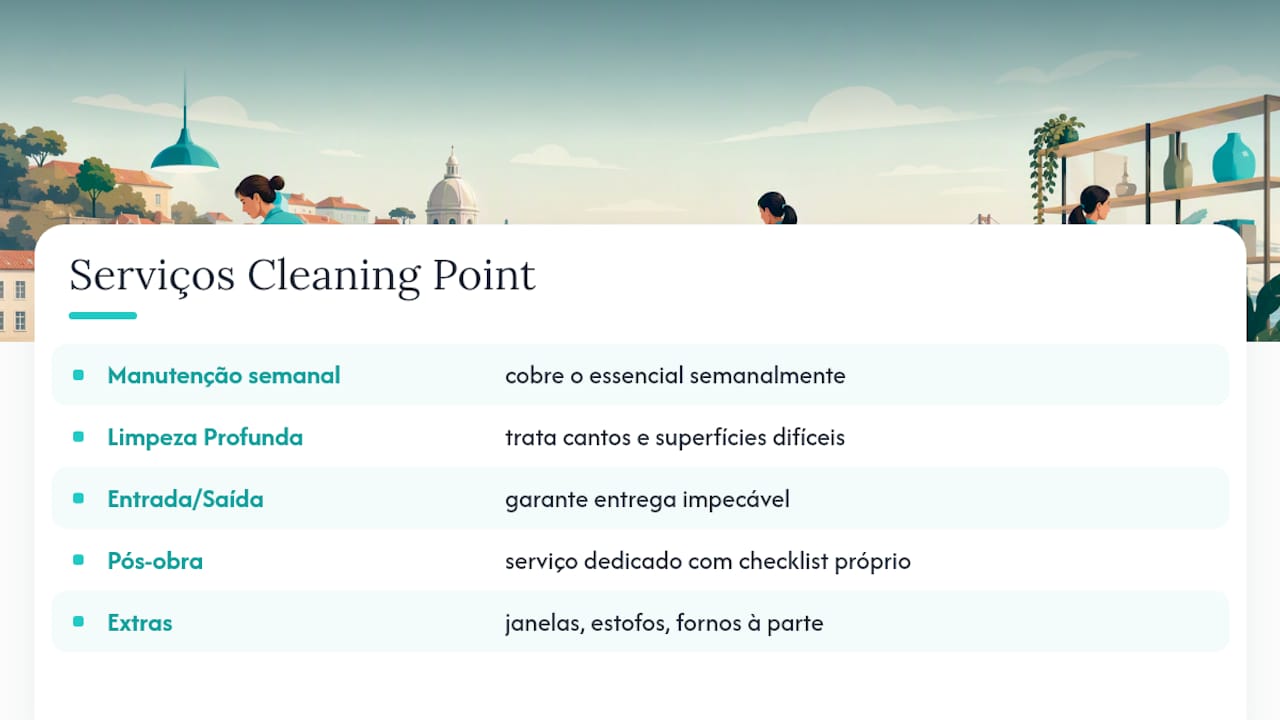
For regular home maintenance, professional home cleaning covers the essentials week after week. If the home needs a deeper intervention, the Signature Deep Cleaning takes care of corners and surfaces that normal routines do not reach. For those moving in or out of a property, move in/move out cleaning ensures that the handover is impeccable, and for post-construction, there is a dedicated service with its own checklist, detailed in the post-construction cleaning guide. Windows, upholstery, ovens, and other extras are available separately, consultable on the extras page.
Applying the room checklist before the team's arrival reduces on-site preparation time and avoids extra costs due to delays. To schedule a visit and choose the service most suitable for your home in Lisbon, visit the cleaning booking page.
Sources
For additional consultation on home safety and cleaning products in Portugal, see the recommendations from CNPDPCJ on child safety and the official guide on product safety in Portugal. For an overview of typical services from a professional cleaning company, consult Supervivo.
- CNPDPCJ — Tip on child safety
- Gov
- What services does a professional cleaning company offer? — Supervivo
Frequently Asked Questions
What should I do before the cleaning team arrives?
Clear surfaces, store fragile or personal items, and ensure agreed access (key, code, or doorman). Communicate two or three clear priorities to the team before starting.
Do I need to be home during the cleaning?
It is not mandatory. You can leave visible written instructions or a formal authorization for entry, previously agreeing on the access method with the company.
How should I store cleaning products if there are children at home?
Store them in high or locked cabinets, out of reach, following the recommendations of CNPDPCJ. Supervise or keep small children away from areas where chemicals are used.
How often should I schedule a deep cleaning?
A deep cleaning every three or four months is usually sufficient for homes with regular maintenance. After renovations, moves, or short-term rentals, it is advisable to schedule one before new occupants move in.
How much does Cleaning Point's professional cleaning cost?
Prices vary by type of service and property size and are not published in a fixed manner. Current rates can be checked directly on Cleaning Point's services page.