Curtain Cleaning: When to Hire or Do It at Home

In summary:
- Professional curtain cleaning is essential for delicate fabrics, with costs varying based on dimensions, fabric, and methods used.
- Services include vacuuming, pre-treatment, proper washing, and controlled drying, ensuring the preservation of the pieces.
For lightweight and lightly soiled curtains, regular home maintenance is sufficient. For everything else, especially long curtains, with blackout lining, in linen, silk, or velvet, or in homes with allergy sufferers, professional cleaning is the right choice. A service with collection and delivery in Lisbon generally costs a variable amount depending on dimensions and fabric, with a timeframe of a few working days for collected pieces. For curtains treated on-site, the service can be completed on the same day.
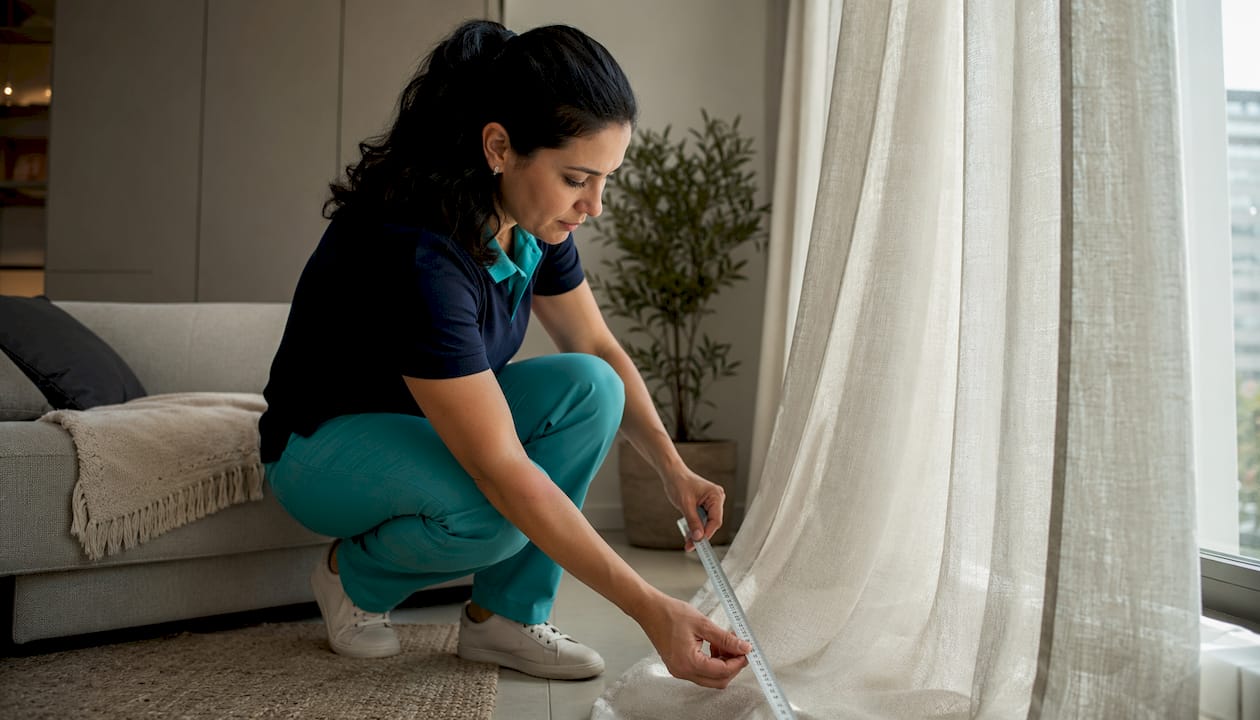
Before requesting a quote, prepare the measurements of each panel (width × height), the type of fabric if known, and indicate if there is lining, blackout, or built-in mechanisms. This information reduces sorting time and allows for an accurate estimate right from the first contact with Cleaning Point.
Index
- What a professional curtain cleaning service usually includes
- How the process works, from collection to reinstallation
- What cleaning method is most suitable for each fabric?
- Typical prices and timeframes in Portugal
- Cleaning curtains at home: when it’s worth it and when it’s not
- How to choose a curtain cleaning provider
- Why professional cleaning protects health and prolongs the life of curtains
- Key takeaways
- What I learned about treating curtains with care
- Cleaning Point takes care of your curtains in Lisbon
- Useful sources to learn more and request quotes
- Frequently asked questions
What a professional curtain cleaning service usually includes
A well-structured service goes far beyond a wash. Here’s what you should expect, and what you should confirm before closing any quote:
- Initial professional vacuuming: removal of accumulated dust with appropriate suction equipment, ideally with a HEPA filter to avoid recontamination of the environment.
- Stain pre-treatment: localized application of neutral products before the main wash, adapted to the type of fiber.
- Cleaning method suitable for the fabric: controlled aqueous washing, dry cleaning, steam cleaning, or low humidity extraction, depending on the material.
- Controlled drying: essential to avoid shrinkage, mold, and deformation of the drape.
- Technical ironing: restores the original drape, especially in structured pieces.
- Final inspection with checklist: checking for residual stains, odors, and overall condition before return.
Additional services, usually charged separately, include disassembly and reinstallation of rods, anti-mite treatment, odor neutralization, and transport with collection and delivery to the home. Always confirm which are included in the base price and which are optional extras.
As for guarantees, any serious provider should have a clear damage policy: what happens if a piece is damaged during the process, who covers the cost, and within what timeframe. Demand this information in writing before handing over the curtains.
Professional tip: Always ask if the provider has liability insurance for damage to clients' property. A lack of a clear answer is a red flag.
How the process works, from collection to reinstallation
The flow of a well-managed professional service follows defined steps, and knowing them helps manage expectations regarding time and logistics.
Initial sorting. Before any intervention, the technician assesses the fabric, either on-site or through previously sent photographs. This step defines the method to be used and identifies stains that require special pre-treatment.
Two distinct operational models. On-site cleaning is done with the curtains hanging, without disassembly, and is indicated for regular maintenance or medium-weight pieces. Collection for specialized laundry is preferable for very delicate, very heavy pieces, or those requiring controlled immersion. Each approach has advantages depending on the fabric and the degree of soiling.
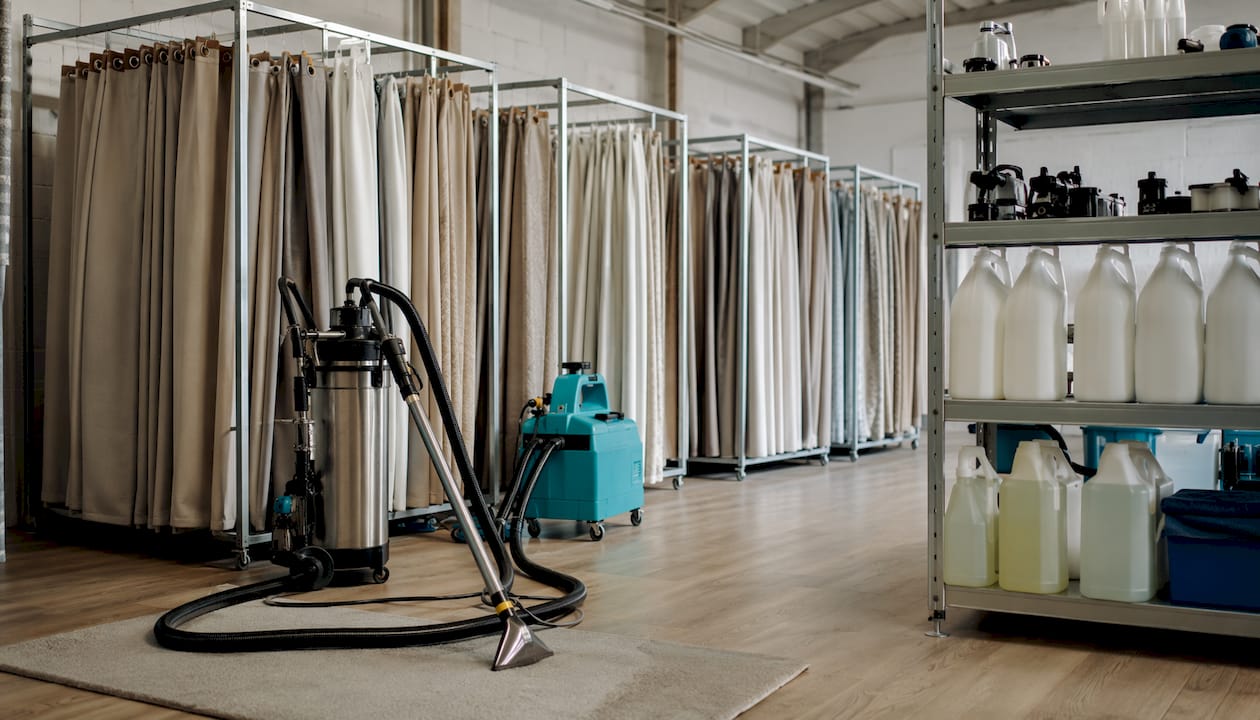
At the cleaning center. After collection, the pieces undergo deep vacuuming, stain pre-treatment, washing by the method defined in sorting, controlled drying, and final ironing. Quality verification occurs before packaging for transport.
Reinstallation and final inspection. When the service includes reinstallation, the technician returns to the home, places the curtains on the rods, and conducts an inspection with the client present. Typical timeframes vary: on-site cleaning is completed in 1 to 3 hours per room; collection for laundry usually takes 2 to 7 working days. During peak demand periods, such as spring and early autumn, the timeframe may increase.
What cleaning method is most suitable for each fabric?
Choosing the wrong method is the most common cause of irreversible damage. The table below summarizes compatibility by technique and type of material.
| Method | How it works | Compatible fabrics | Fabrics to avoid |
|---|---|---|---|
| Controlled aqueous washing | Immersion or gentle cycle with neutral detergent | Polyester, cotton, lightweight voile | Silk, 100% linen, structured velvet |
| Dry cleaning | Solvents without water, no immersion | Silk, delicate voile, linen, velvet | Fabrics with rubber coating |
| Steam cleaning | High-temperature steam, without wetting the fabric | Most synthetic fabrics, cotton | Raw silk, fabrics with glue or thermally bonded linings |
| Low humidity extraction | Vacuuming with minimal cleaning solution | Blackout, roller blinds, Roman shades, curtains with hardware | Fabrics that cannot tolerate any moisture |
Low humidity extraction is especially important for curtains with internal mechanisms or thermoacoustic linings. When water penetrates structures like heavy rods or linings with rubber, it causes oxidation of the hardware and delamination of the linings, damage that is not easily repaired.
Another little-discussed risk: acidic or alkaline homemade products, such as vinegar or baking soda, alter the pH of natural fibers like linen and silk, causing permanent stains or weakening the fibers. Professional technicians use neutral detergents and always test in a hidden area before treating the entire piece.
Professional tip: If you do not know the type of fabric of the curtain, look for the composition label on the bottom hem. This information is sufficient for the technician to define the correct method during sorting.
By identifying the material of the curtains before contacting a provider, you save time in sorting and avoid surprises in the quote.
Typical prices and timeframes in Portugal
The cost of a professional curtain cleaning service varies significantly, and understanding what influences the price helps in requesting more accurate quotes and comparing proposals fairly.
Factors that most influence the price:
- Panel size: tall curtains (over 2.5 m) or wide ones require more time and effort.
- Type of fabric: silk, velvet, and linen require more careful methods and specific products.
- Need for disassembly and reinstallation: when included, it represents a significant additional cost.
- Transport with collection and delivery: services with home visits have an associated logistical cost.
- Additional treatments: anti-mite, waterproofing, and odor neutralization are charged separately.
- Urgency: reduced timeframes may imply a price increase.
- Number of panels: the larger the volume, the more likely you are to obtain a more favorable unit price.
As a guideline, on-site cleaning services in Portugal usually have a variable cost per panel for standard fabrics, which may be higher for large pieces or delicate materials. Services with collection, washing at specialized laundry, and delivery typically incur additional charges, reflecting transport and processing time.
Typical timeframes for on-site cleaning per room take a few hours, and for collection and return can be several working days. During peak seasonal demand periods, the timeframe may increase. It is advisable to schedule in advance if you need the curtains ready for a specific date.
Cleaning curtains at home: when it’s worth it and when it’s not
Home washing has its place, but the risks are real and often underestimated.
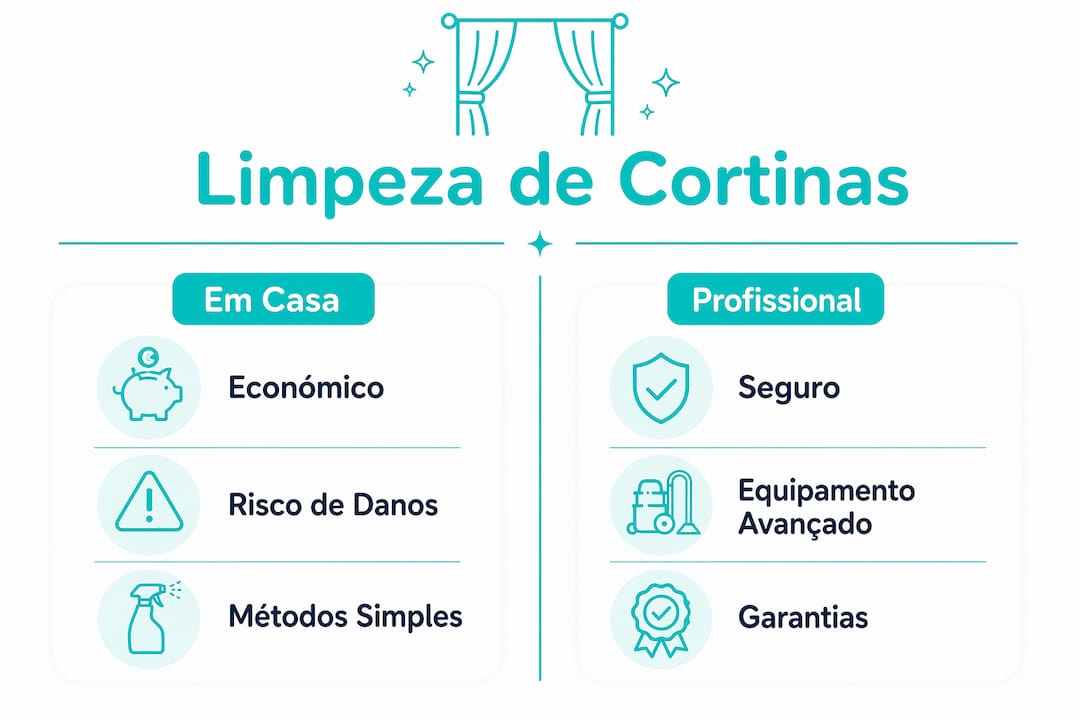
The biggest danger is not the washing machine itself: it’s handling the wet fabric. Long or heavy curtains become very heavy when soaked, which causes permanent deformation of the drape and, in some cases, tears in the rings or hem. Slow drying in a closed environment promotes the growth of mold, which leaves dark stains that are difficult to remove.
When cleaning at home is reasonable: lightweight polyester or cotton curtains, without lining, with little accumulated dirt, and with a label that allows machine washing. In these cases, use a delicate cycle at 30 °C, a protective bag for delicate clothing, neutral detergent, and hang to dry immediately after washing.
When you should not attempt: blackout (the rubber coating does not tolerate immersion), 100% linen, silk, velvet, curtains with thermally bonded lining, pieces with rods or integrated mechanisms, and any curtain over 2.5 m in height. For these, the risk of irreversible damage clearly outweighs the savings.
For everyday maintenance, regular vacuuming with a brush nozzle is the best protection. Spot stains are treated with a slightly damp white cloth, without scrubbing, and always with a test in a hidden area first.
How to choose a curtain cleaning provider
Before closing any service, use this checklist to evaluate the provider.
Essential questions to ask:
- Do you have experience with this specific type of fabric (linen, silk, blackout, velvet)?
- Is the service done on-site or with collection for laundry? What is the difference in timeframe and price?
- What cleaning method will be used and why?
- What is the policy in case of damage? Is there liability insurance?
- Does the quote include disassembly and reinstallation, or are they charged separately?
- What is the delivery timeframe and what happens if there is a delay?
Practical decision criteria:
- Detailed quote per panel, not just a global amount.
- Collection and delivery option confirmed in writing.
- Verifiable reviews on Google or independent platforms.
- Service checklist available for consultation before booking.
- Clear support for communication (phone, email, or message).
Red flags to avoid:
- Quote given without any prior assessment of the fabric or dimensions.
- Absence of a damage policy or vague response when asking about insurance.
- Pressure to accept additional treatments at the time of delivery, without prior notice.
- No verifiable online reviews or references from previous clients.
By checking reviews on the Consumer Portal or independent platforms, you have an objective basis to compare providers before deciding.
Why professional cleaning protects health and prolongs the life of curtains
Curtains are one of the largest reservoirs of dust, mites, and pollutants in the home, precisely because they remain exposed to moving air for years without deep intervention. Regular professional cleaning brings benefits that go beyond appearance: it improves indoor air quality, removes accumulated odors, and preserves the structure of the fabric, prolonging the lifespan of pieces that represent a significant investment.
In homes with children, the elderly, smokers, or pets, professional sanitization should be seen as a preventive health measure. Curtains saturated with mites and allergens exacerbate rhinitis and asthma, and home cleaning rarely removes these agents effectively.
The technical difference lies in the equipment. Vacuuming with HEPA filters retains particles that a common household vacuum recirculates into the air. Controlled drying eliminates the risk of mold. Neutral products tested on natural fibers prevent damage that only appears weeks later. These three factors combined are what separates professional cleaning from a well-intentioned home wash.
Cleaning Point follows detailed checklists in each intervention, with trained teams and support in multiple languages, ensuring consistency regardless of the piece or type of fabric. For homes in Lisbon that include delicate curtains or sensitive environments, this level of detail makes a difference.
The recommended frequency for homes with allergies, pets, or high dust exposure is professional sanitization every 6 to 12 months. Under normal conditions, once a year is sufficient for most curtains.
Key takeaways
Professional curtain cleaning is the safest choice for delicate fabrics, pieces with lining or blackout, and homes with allergy sufferers, with costs and timeframes varying mainly with dimensions and the necessary method.
| Point | Details |
|---|---|
| When to hire a professional | Delicate fabrics (silk, linen, velvet), blackout, heavy curtains, or homes with allergy sufferers. |
| What to prepare for the quote | Measurements of each panel, type of fabric, presence of lining or blackout, and number of panels. |
| Factors that most influence the price | Size, type of fabric, disassembly/reinstallation, transport, and urgency. |
| Typical timeframe | On-site cleaning: 1–3 hours per room; collection and delivery: 2–7 working days. |
| Cleaning Point in Lisbon | Premium service with detailed checklists, trained teams, and multilingual support for curtains and complete home cleaning. |
What I learned about treating curtains with care
There is one mistake I see repeatedly: people wait too long between cleanings, and when they finally decide to act, the curtains have already accumulated years of dust, mites, and odors that make the process more difficult and expensive than it would be with regular maintenance.
What surprises me most is the resistance to treating curtains as part of home maintenance, rather than as an extra. A well-cared-for linen curtain lasts for decades. The same curtain washed at home with the wrong method can shrink or lose its drape in a single wash. The difference between the two outcomes is not in the price of the service, but in the decision to act before the problem is visible.
At Cleaning Point, sorting begins before the visit. We ask for photographs and measurements of the pieces so that the technician arrives already with the method defined and the right products. When there is doubt about the fabric, we test in a hidden area before any intervention. This is not bureaucracy: it is what prevents unpleasant surprises for the client and for us.
What I recommend to anyone considering: do not wait for the curtains to look dirty to clean them. Dust and mites are not visible, but they are there. An annual cleaning, integrated into a regular home maintenance plan, is cheaper and more effective than an emergency intervention on a saturated piece.
Cleaning Point takes care of your curtains in Lisbon
Cleaning Point offers curtain cleaning as part of its deep cleaning service in Lisbon, with methods adapted to the type of fabric, trained teams, and verification checklists in each intervention. The service covers curtains of all types, from lightweight voile to structured blackout, with the option of collection and delivery to the home.
To receive a quick quote, send the measurements of each panel (width × height), the type of fabric if known, and indicate if there is lining, blackout, or built-in mechanisms. The more information you provide, the more accurate the proposal will be. Available extras include disassembly and reinstallation, anti-mite treatment, and odor neutralization.
To schedule or request a quote, book your cleaning directly on the website.
Useful sources to learn more and request quotes
Cleaning Point pages:
- Services available in Lisbon — overview of the offer and service levels.
- Detailed checklist of what is cleaned — transparency about what is included in each visit.
- Schedule a cleaning — direct scheduling and quote request.
Technical resources on methods and fabrics:
- Curtain and blind cleaning — care and techniques — detailed explanation of professional methods and compatibility by material.
- Professional cleaning equipment — reference on tools used by professionals and differences compared to household equipment.
Provider verification and consumer rights:
- Consumer Portal — to check complaints, rights in case of damage, and how to file a complaint if the service does not meet the agreement.
Frequently asked questions
How long does a professional curtain cleaning take?
On-site cleaning takes between 30 minutes and 1 hour per room, depending on the quantity and type of curtains. With collection for specialized laundry, the usual timeframe is 2 to 7 working days.
How often should I have professional curtain cleaning?
The general recommendation is once a year. In homes with allergies, pets, smokers, or greater exposure to dust, the interval should be reduced to 6 to 12 months.
What does a deep curtain cleaning include?
It includes professional vacuuming, stain pre-treatment, washing by the method suitable for the fabric, controlled drying, and final verification. Disassembly, reinstallation, and anti-mite treatments are usually extras charged separately.
Can I wash blackout curtains at home?
It is not recommended. The rubber coating of the blackout does not tolerate immersion in water and may delaminate or deteriorate. Low humidity extraction, done by professionals, is the safest method for this type of curtain.
How much does curtain cleaning cost in Portugal?
The price varies with dimensions, type of fabric, and included services. As a guideline, on-site services usually have a variable cost per panel for standard fabrics, which may be higher for large pieces or delicate materials. Always request a detailed quote before confirming.