Professional Oven Cleaning in Lisbon: When It’s Worth Hiring

Professional oven cleaning is the on-site service that removes ingrained grease and sanitizes the interior of the oven, including racks, trays, and seals. It makes sense to hire when dirt resists domestic cleaning, there are persistent odors, or you are preparing the house for new tenants. In Lisbon, a premium option combines this service with checklists and a digital report of the work done.
In summary:
- A professional cleaning eliminates grease, odors, and residues throughout the oven's interior, including hard-to-reach areas, and should be done when dirt persists or before tenant changes.
- Available professional methods include steam, manual cleaning, and pyrolysis, with the appropriate method chosen based on the oven's condition to avoid damage from incorrect actions, such as applying hot water to a still-hot oven.
- Cleaning frequency depends on usage; heavily used ovens benefit from monthly or weekly cleanings, while occasional use requires less frequent intervention.
- When signs like corrosion, persistent odors, or resistant grease appear, it’s time to call a professional, as domestic cleaning is no longer sufficient.
- To ensure quality service, inquire about the method used, products applied, the team's civil liability, and request digital reports with before and after photographs of the procedure.
Index
- What’s included in a professional oven cleaning
- Professional methods: steam, manual cleaning, and pyrolysis
- How often to clean the oven and when to call a professional
- Checklist before scheduling a premium service in Lisbon
- The day of the intervention: what to expect and how the price is calculated
- Cleaning Point’s perspective on premium service
- Schedule your oven cleaning with Cleaning Point
- Sources
- Frequently Asked Questions
What’s included in a professional oven cleaning
A well-done professional oven cleaning covers the entire interior of the appliance, not just the visible areas. The cavity, racks, trays, the door with the inner glass, and the door seals are all included in the service scope, with extra attention to the latter: a poorly cleaned or damaged seal causes heat leaks and loss of energy efficiency.
Components covered in a standard cleaning:
- Interior cavity, including side walls and ceiling
- Racks and trays, disassembled for deeper cleaning
- Door and inner glass, removing accumulated grease between layers when the model allows
- Seals and door gaskets, using neutral products
- Control panel, exterior cleaning only, without electrical intervention
What is excluded from the standard service are technical repairs: replacement of heating elements, adjustment of thermostats, or repair of electrical leaks. If the professional identifies one of these issues during cleaning, the correct approach is to refer the case to a specialized technician rather than attempting to resolve it.
The expected result is concrete: visible reduction of burnt odors, elimination of charred grease crusts, and a sanitized interior that leaves no chemical residues. Do not expect cleaning to correct mechanical problems or replace a malfunction.
Professional methods: steam, manual cleaning, and pyrolysis
Each professional method addresses a different problem, and choosing the wrong one can cost time or damage the appliance.
Steam cleaning combines water, heat, and pressure to soften charred grease without resorting to aggressive chemicals. It is particularly effective on old deposits and also helps eliminate bacteria and fungi solely through the thermal action of steam. It is the preferred method when deep sanitization is desired without leaving a chemical smell.
Manual cleaning with degreasers is still necessary in specific points, such as tight corners or areas near seals where steam cannot act as effectively. Here, care should be taken to avoid products with chlorine or abrasive sponges on enamel surfaces, as recommended by the manufacturers themselves.
Pyrolysis (or the hydrolytic cycle, in simpler models) is the self-cleaning system of the oven itself, at high temperatures. It works well in ovens without prior damage to the enamel but should be avoided if there are already cracks or peeling areas, as extreme heat exacerbates these damages.
- Steam: charred grease, sanitization without chemicals
- Manual: specific points, seals, sensitive areas
- Pyrolysis: regular maintenance in ovens without structural damage
Professional tip: Never apply cold water or degreaser to a still-hot oven. The thermal shock can crack the interior enamel and damage electrical components, a mistake any experienced professional avoids at all costs.
How often to clean the oven and when to call a professional
The ideal frequency depends on usage, not the calendar. Ovens used intensively accumulate grease much faster than common sense suggests.
- Frequent use (three or more times a week): light weekly cleaning of visible surfaces and a deep monthly cleaning to remove what accumulates in the cavity and on the racks.
- Occasional use: a complete monthly or bimonthly cleaning is generally sufficient, adjusting according to the level of visible dirt.
- Before tenant changes or property sales: a one-time deep cleaning, regardless of previous usage frequency.
Certain signs indicate that domestic cleaning is no longer sufficient and it’s time to hire a professional: visible corrosion inside, persistent odors that do not disappear after a normal cleaning, charred dirt that resists common degreasers, or heat leaks through the door seal. This last sign is particularly important: it means that the oven is consuming more energy than it should, because accumulated grease acts as thermal insulation.
Professional cleaning complements pyrolysis in ovens that have it, serving to treat areas that the automatic cycle does not reach well, such as seals and exterior glass. When the problem is mechanical (faulty heating element, electrical leak), cleaning does not resolve it. In that case, the next step is always a service technician.
Checklist before scheduling a premium service in Lisbon
Before booking any visit, it’s worth preparing the ground and asking the right questions to the provider.
The day before the visit, confirm that the oven is turned off with enough time to cool completely, that there is free access to the appliance, and that nearby surfaces (countertops, floor) are protected or easy to clean afterward.
Before confirming the booking, ask:
- What method will they use (steam, manual, or both) and why for your case
- What products they apply on enamel surfaces and seals
- If the team is fixed or varies with each visit
- If there is civil liability insurance in case of damage to the appliance
- How problem resolution works if something does not go well
Professional tip: Always request a digital report with photographs before and after. A provider that documents the work has less room for disputes about the final result.
Signs of trust to look for: detailed checklists for each service, clear communication about what is included, support in multiple languages (relevant in Lisbon, with many foreign residents), and clear policies on liability in case of incidents.
The day of the intervention: what to expect and how the price is calculated
The flow of a professional oven cleaning typically follows a predictable sequence: initial inspection of the appliance's condition, protection of surrounding surfaces, the actual cleaning with the chosen method, drying, and a final check before the team leaves.
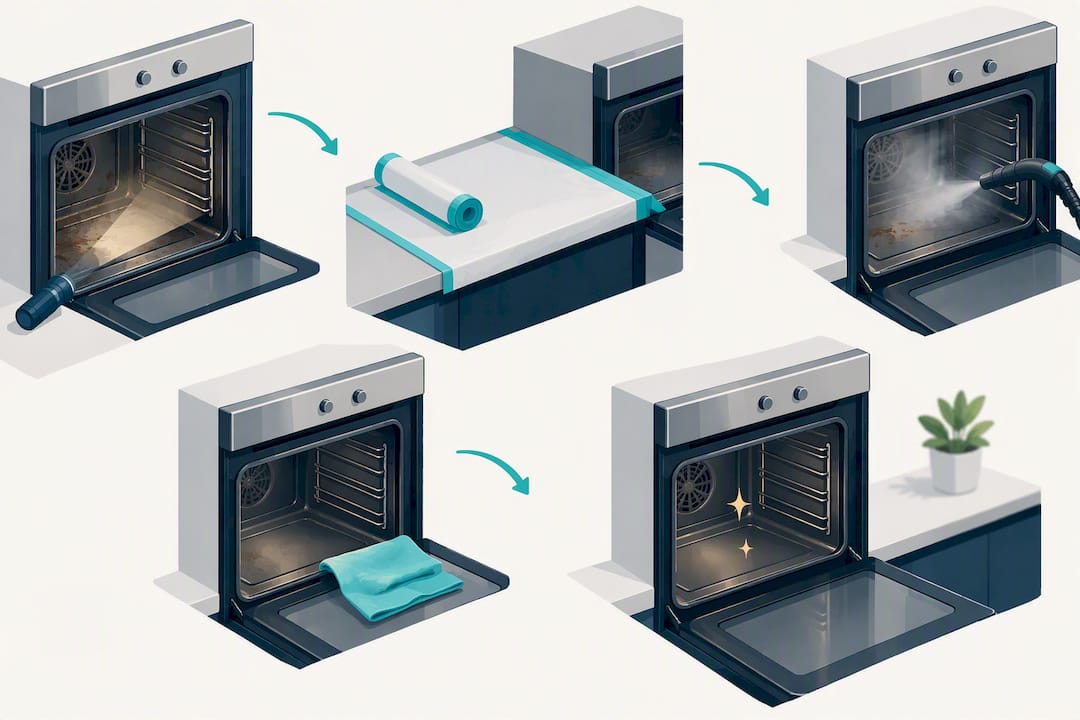
The duration varies significantly with the oven's condition, ranging from less than an hour for simple cleanings to several hours for deep cleanings in cases of heavy grease accumulation.
The price usually follows one of two models: by the hour, common in regular maintenance, or by visit, more frequent in deep cleanings with a defined scope in advance. Factors that increase the final cost include disassembly of difficult-to-remove parts, detailed cleaning of the glass between layers of the door, and removal of heavily charred residues that require extra manual work time.
Cleaning Point’s perspective on premium service
What separates a decent oven cleaning service from a truly good one is not the product used, but consistency. Cleaning Point has built its offering in Lisbon precisely on this idea: trained teams, detailed checklists for each service, and support in multiple languages, so that the result does not depend on which professional showed up at the door that day.
This matters more than it seems at first glance. A clean oven today and a poorly cleaned one on the next visit is not a reliable service; it’s luck. The difference between the two lies in written processes and a team that always follows them in the same way.
— Taras
Schedule your oven cleaning with Cleaning Point
If your oven has charred grease, persistent odors, or you are preparing the house for new tenants, Cleaning Point resolves this without wasting time comparing scattered providers: oven cleaning is included as an extra within the deep cleaning service, with the same trained team and checklist that takes care of the rest of the house.

For ovens with heavily ingrained grease, the Signature Deep Cleaning includes detailed intervention in the kitchen and appliances. If you are looking for just the one-off extra, check the list of available extras, where oven and appliance cleaning can be added to an already scheduled visit. All visits follow written checklists and end with a small report of the work done, which avoids surprises and disputes about the result.
The next step is simple: schedule your cleaning online and indicate that you want to include the oven in the scope of the service.
Sources
- Dr. Beckmann – How to clean the oven
- Beko – Tips to extend the life of the oven
- Polti – How to clean the oven
- Walltom – How to clean a very dirty electric oven
- Elica – FAQ about oven cleaning
Frequently Asked Questions
How much does a professional oven cleaning cost in Lisbon?
The price varies with the chosen method, the oven's condition, and whether it is charged by the hour or by complete visit. Cleaning Point has current prices available on the services site, as the final value depends on the agreed scope.
Is steam cleaning safe for all ovens?
It is safe for most domestic ovens, but it’s advisable to confirm with the manufacturer if the model has any specific restrictions. Steam softens charred grease without aggressive chemicals, making it suitable for both conventional enamels and more sensitive coatings.
How often should I clean the oven professionally?
For frequent use, three or more times a week, a deep monthly cleaning is recommended. For occasional use, monthly or bimonthly is usually sufficient, depending on visible dirt.
Does pyrolysis replace professional cleaning?
Not completely. Pyrolysis effectively treats the interior cavity in ovens without prior damage to the enamel, but it does not reach seals, exterior glass, or specific areas with the same effectiveness as manual or steam cleaning done by a professional.
What should I ask before hiring an oven cleaning service?
Ask what method they use, what products they apply on enamel surfaces, if they have civil liability insurance, and if the team is fixed. Reliable providers should respond to this with detailed checklists and a digital report of the work performed.