Mould in a Closed House: How to Identify, Clean and Prevent

If you find mould in a closed house, the first thing to do is isolate the area, open a window on the opposite side to create air circulation, and protect yourself before touching any surface. Only after reducing humidity and assessing the extent of the problem does it make sense to act on the stains.
Immediate actions to take in the first minutes:
- Close the door of the affected room to prevent spores from spreading throughout the house.
- Open a window in that room or an adjacent one to create cross ventilation.
- Turn on the bathroom or kitchen extractor fan if nearby.
- Remove damp or hung clothes inside.
- Wear disposable gloves and, if possible, an FFP2 mask before approaching.
Professional tip: Position a portable dehumidifier in the center of the affected room while diagnosing the cause. A basic model can help lower relative humidity, making the environment less conducive to spore propagation.
Key Takeaways
Mould in closed houses almost always results from condensation, infiltration, or rising damp, and only disappears permanently when the cause is corrected, not just the stain.
| Point | Details |
|---|---|
| Ideal humidity: 40%–50% | Above 50% RH, the risk of fungi and damage to materials increases significantly. |
| 1 m² rule | Stains larger than 1 m² or recurring require professional technical assessment. |
| Safe DIY cleaning | Use gloves, FFP2 mask, and never mix bleach with vinegar on porous surfaces. |
| Daily prevention | Ventilate for 10–20 minutes, 2–3 times a day, and always use the extractor in the kitchen and bathroom. |
| Cleaning Point in Lisbon | Deep cleaning with a digital report and recurring maintenance for homes with humidity problems. |
Index
- 1. Why does mould appear in a closed house
- 2. How to assess severity: visible signs and simple measurements
- 3. How to safely clean small stains
- 4. When not to try alone: signs that require professional intervention
- 5. How to prevent mould from returning: daily habits and underlying interventions
- 6. When to hire a professional cleaning service in Lisbon
- 7. Addressing causes, not just stains
- Cleaning Point: deep cleaning for homes with humidity problems
- Sources
- Frequently Asked Questions
1. Why does mould appear in a closed house
Condensation is the most frequent cause of mould in Portuguese homes. It occurs when the water vapor produced indoors — from cooking, bathing, or simply breathing — comes into contact with cold surfaces such as unbroken thermal glass, poorly insulated exterior walls, or corners of poorly heated rooms. In a closed house, where air renewal is minimal, this vapor accumulates until it reaches saturation point.
However, there are other origins worth distinguishing:
- Infiltrations: water enters from the outside through cracks in the facade, damaged roofs, or poorly sealed window frames. Stains tend to appear near windows, on ceilings, or on exterior walls, and are often accompanied by efflorescence (white deposits of mineral salts).
- Rising damp: rises through building materials from the ground. It manifests in the lower parts of walls, with stains that progressively rise and do not disappear with ventilation.
- Domestic habits: drying clothes indoors, cooking without the extractor fan on, or having many people in a small room can increase relative humidity by several percentage points in just a few minutes.
In Portugal, the problem is exacerbated by the aging housing stock. Many homes have insufficient insulation and window frames without thermal breaks, creating permanently cold surfaces in winter, even with heating on.
Humidity reference: according to Casa Galp, the ideal levels of indoor relative humidity are within a considered ideal range. Above this range, the risk of fungal growth and damage to materials increases significantly.
2. How to assess severity: visible signs and simple measurements
Before acting, it is necessary to understand what you are dealing with. Small stains on a smooth surface are very different from structural infiltrations or fungi hidden behind furniture.
Signs to look for:
- Dark stains (black, grey, or greenish) in corners, ceilings, or behind furniture against the wall.
- Bubbles or peeling paint, especially on exterior walls.
- Persistently fogged glass, even outside of bathing periods.
- Musty smell in the house that persists even after airing — may indicate invisible fungi in porous materials or cavities.
- Stains with damp edges or that reappear days after superficial cleaning.
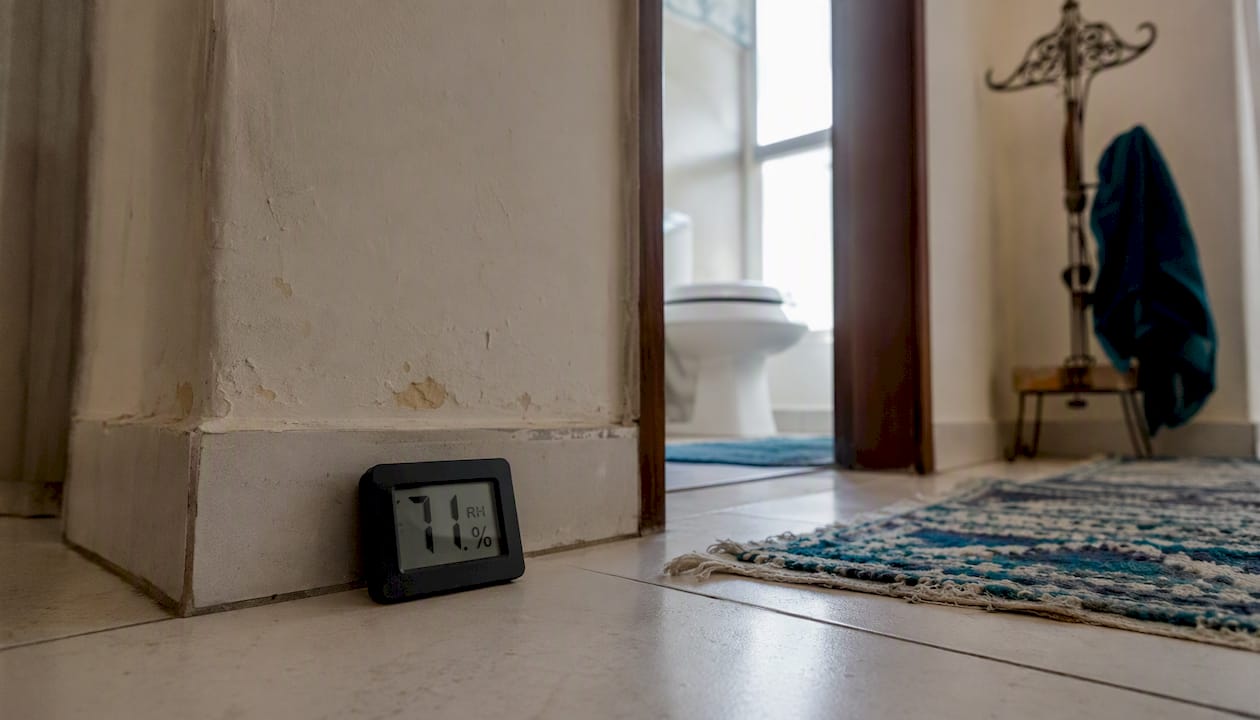
The most useful instrument for assessing the situation is a digital hygrometer, available for less than €15 in DIY stores. Place it in the affected room and record readings at different times of the day.
| Relative humidity (RH%) | Interpretation | Recommended action |
|---|---|---|
| 30%–40% | Air too dry | Consider a humidifier |
| 40%–50% | Ideal range | Maintain and monitor |
| 60% | Attention | Increase ventilation, use dehumidifier |
| Above 60% | Intervention needed | Active dehumidification and diagnosis of origin |
The most cited practical rule by technicians and specialized guides is simple: if the affected area is extensive, or if the mould reappears repeatedly after cleaning, do not try to solve it alone.
Professional tip: Record hygrometer readings immediately after bathing, after cooking, and at the end of the day. This pattern reveals which activities contribute most to humidity spikes and where to focus corrective measures.
3. How to safely clean small stains
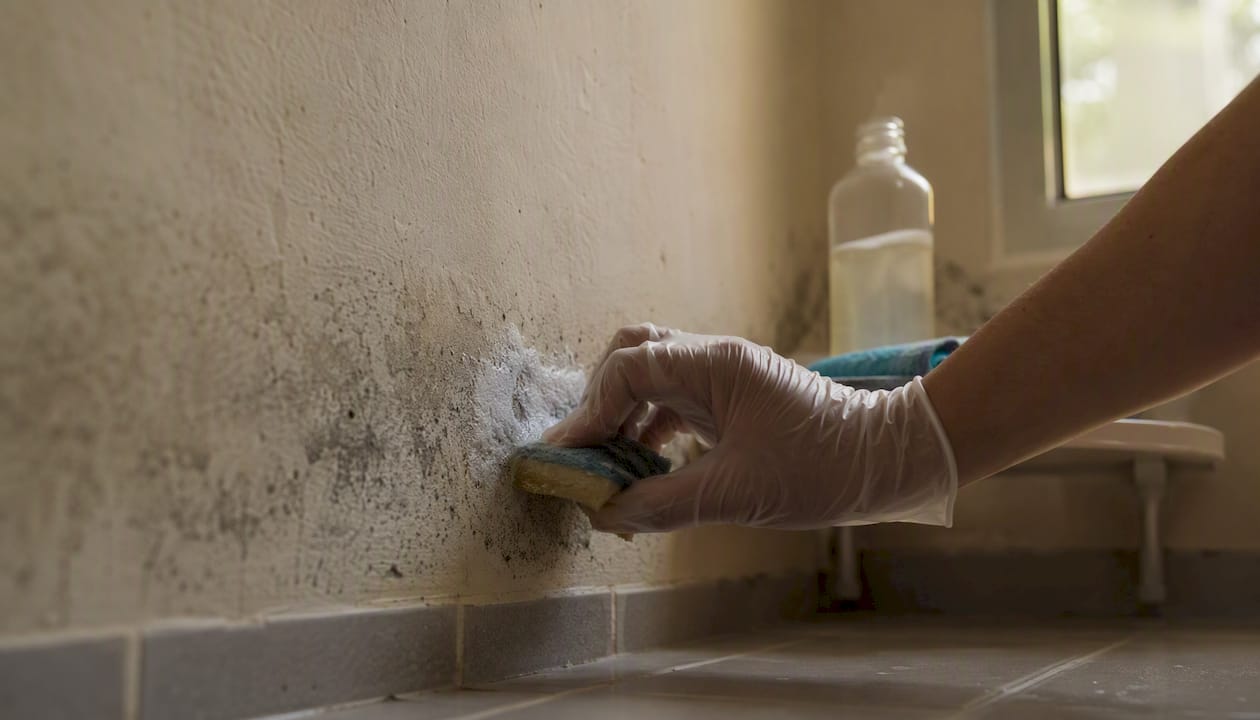
For stains less than 1 m² on non-porous surfaces (tiles, glass, metal), DIY cleaning is feasible if you follow a careful procedure.
Necessary equipment:
- Chemical-resistant rubber gloves.
- FFP2 mask (not a simple surgical mask).
- Safety goggles.
- Disposable cloths or short-handled brushes.
- Clean spray bottle.
Steps:
- Isolate the area: close doors to other rooms and open the window of the room where you will work.
- Test in a small area: apply the chosen solution in a discreet corner and wait 5 minutes to check the surface's reaction.
- Apply the solution: for porous surfaces (plaster, wood), diluted white vinegar or specific antifungal products are preferable. On tiles or glass, a diluted bleach solution (1 part to 10 of water) is effective.
- Gently scrub: use soft circular motions without excessive pressure that disperses the spores.
- Dry completely: use a dry cloth or a small fan pointed at the surface. Residual moisture is the main factor for recurrence.
- Dispose of materials: place used cloths and brushes in a sealed plastic bag before throwing them in the trash.
⚠️ Safety warning: never mix bleach with vinegar. The combination produces chlorine gas, which is toxic. Additionally, bleach on plaster walls may only whiten the surface and introduce more water into the wall mass, favoring the reappearance of fungi weeks later.
After cleaning, monitor the area for 3–4 weeks before repainting. When repainting, use anti-mould or anti-damp paint formulated for interiors, which contains fungicides that slow down reappearance.
4. When not to try alone: signs that require professional intervention
There are situations where DIY cleaning is not only ineffective but can worsen the problem. Recognizing these signs saves time, money, and health risks.
Call a professional when:
- The affected area exceeds 1 m² or extends across several rooms.
- Mould reappears weeks after cleaning, even with improved ventilation.
- There is suspicion of infiltration (stains near windows, ceilings, or exterior walls after rain).
- Stains are on the lower parts of walls and progressively rise (a sign of rising damp).
- The musty smell persists even without visible stains, which may indicate fungi in cavities or building materials.
- People with asthma, respiratory allergies, babies, or the elderly live in the house.
A professional technical assessment typically includes diagnosing the origin (condensation, infiltration, or capillarity), a report with photographs, recommendations for structural repair, and a decontamination plan. According to SIC, when humidity is persistent or localized and does not yield to ventilation, correctly identifying the origin prevents ineffective and costly interventions.
When choosing a service, check if they have experience in decontaminations (not just aesthetic cleaning), if they provide a before/after report, and if they offer a guarantee on the work performed.
5. How to prevent mould from returning: daily habits and underlying interventions
Resolving visible mould without addressing the cause is wasted effort. Prevention combines behavioral changes with, when necessary, physical interventions in the home.
Daily measures:
- Ventilate through opposite windows for a few minutes, several times a day, whenever external conditions allow. DECO PROTESTE recommends this practice as one of the most effective for controlling condensation.
- Always turn on the extractor fan when cooking and bathing, and keep it on for some time after finishing. Regular cleaning of the extractor fan ensures it operates at maximum capacity.
- Avoid drying clothes indoors; if unavoidable, open the window of the room where the clothes are.
- Keep heating stable: sharp temperature fluctuations create condensation on cold surfaces.
Use of dehumidifiers:
As a general rule, a model of 10–12 liters per day covers rooms up to 30–40 m². Position it in the center of the room, away from walls, and empty the tank daily. Clean the filter every 2–4 weeks.
In winter, ventilation with very humid outside air may be insufficient. In this case, the combination of heating and active dehumidification is more effective than just ventilating, as referenced in studies by INSA.
Structural interventions when necessary:
| Cause | Recommended construction solution |
|---|---|
| Condensation due to poor insulation | Application of ETICS (insulation) or interior insulation; replacement of window frames with thermal break profiles |
| Infiltration through the facade or roof | Waterproofing facades; roof repair; sealing cracks |
| Rising damp | Injection of hydrophobic resins at the base of walls; peripheral drainage |
| Insufficient ventilation in sealed spaces | Installation of mechanical ventilation with heat recovery |
These works are described by specialists as durable technical solutions for homes with chronic humidity problems.
Professional tip: Before winter, do a round of the house with the hygrometer and record readings room by room. Compare with last winter's readings to detect trends before the problem sets in.
6. When to hire a professional cleaning service in Lisbon
There are situations where professional cleaning is not a luxury but the only way to ensure the problem does not reappear. Cleaning Point, with services in Lisbon, offers specific interventions for homes affected by humidity and mould.
What Cleaning Point can do:
- Deep cleaning of affected surfaces, including walls, ceilings, skirting boards, and areas behind furniture, with products suitable for each type of surface.
- Decontamination of textiles and upholstery that may have absorbed spores.
- Cleaning of windows and frames, where condensation tends to accumulate first.
- Inspection and cleaning of holiday homes or secondary residences before seasonal occupancy, where dust and mould accumulate during closure months.
- Contracts for recurring maintenance to maintain hygiene levels and detect early signs of humidity.
The process includes detailed checklists, a digital report with photographs, and a consistent team, making it easier to compare visits and detect recurrences. Coverage includes the entire Lisbon area, with the possibility of scheduling technical visits or recovery cleanings as needed.
For a holiday home that has been closed for several months, seasonal cleaning before reopening is especially relevant: accumulated dust, stagnant humidity, and any musty smell require a more comprehensive intervention than regular maintenance cleaning.
7. Addressing causes, not just stains
After years of working in homes in Lisbon, the conclusion is always the same: cleaning stains without resolving the origin is like drying the floor with the tap open. The stain disappears, but the fungus is in the wall, in the plaster, sometimes already in the insulation. Weeks later, it is back.
The most common cases are two. The first is condensation in old window frames without thermal breaks: the glass surface remains permanently cold in winter, the vapor condenses, runs down to the sill, and settles in the plaster. The solution is not just to clean; it is to replace the window frames or, at a minimum, improve ventilation and heating in the room.
The correct approach always involves two steps: first, accurately diagnose the origin, then intervene on the surface and the cause simultaneously. The before/after reports that Cleaning Point provides serve precisely to document this process and confirm that the problem has been resolved at the root, not just cosmetically.
Cleaning Point: deep cleaning for homes with humidity problems
When mould is already established and DIY cleaning is not enough, the difference lies in the depth of the intervention. Cleaning Point offers a deep cleaning service in Lisbon designed for homes affected by humidity: surfaces treated room by room, detailed checklists, a digital report with before and after photographs, and a specialized team that knows how to distinguish a superficial stain from a structural problem.

For holiday homes or residences that have been closed, seasonal cleaning before reopening prevents the accumulation of humidity and spores from becoming a bigger problem. For occupied homes with recurring mould, regular maintenance contracts allow for early detection of signs before they settle in.
Schedule your deep cleaning in Lisbon and receive a complete report on the state of the home.
Sources
To delve deeper into each aspect covered in this guide:
- Managing humidity levels
- Humidity in the house: how to avoid and prevent | Casa Galp
- Mould on the walls and musty smell? What is causing humidity in your home (and how to solve it) - SIC
- How to eliminate excess humidity | DECO PROTESTE
- Mould on the walls: how to clean quickly and eliminate humidity? — idealista/news
This article provides general information and does not substitute for the advice of a qualified physician. Consult a qualified health professional about your case before acting based on this content.
Frequently Asked Questions
How to eliminate mould permanently?
Permanent elimination requires two steps: removing stains with antifungal products suitable for the surface and correcting the cause (condensation, infiltration, or rising damp). Without addressing the origin, mould returns in weeks.
What is the best product for cleaning mould on walls?
On non-porous surfaces, a diluted bleach solution (1:10) is effective. On plaster or wood, white vinegar or specific antifungal products are preferable, as bleach can introduce additional moisture into the wall and worsen the problem in the medium term.
How to remove humidity from interior walls?
If humidity persists after these measures, it is necessary to identify the origin (infiltration or capillarity) and intervene structurally.
How to prevent mould on the walls of a closed house?
Ventilate for 10–20 minutes, 2–3 times a day, keep heating stable, use extractors in humid areas, and monitor relative humidity with a hygrometer. For houses that remain closed for long periods, professional seasonal cleaning before reopening prevents the accumulation of spores.


