How to complain about a cleaning service: practical and legal guide in Portugal
If you are dissatisfied with a cleaning service, the first step is to contact the company and document that contact, whether by email, SMS, or registered letter. If the company does not resolve the issue within a reasonable timeframe, the next step is to file a complaint in the Complaints Book, either physical or electronic. If the conflict persists, you can turn to a Consumer Dispute Arbitration Centre or use the form from the Directorate-General for Consumers (DGC).
Before proceeding with any formal route, it is worth keeping in mind the logical order of steps:
- Contact the company and keep written proof of the contact
- Gather invoice, contract, and photographs of the issue
- Submit a complaint in the Complaints Book if there is no satisfactory response
- Seek arbitration or the DGC if the deadlock continues
Key Takeaways
Complaining about a cleaning service in Portugal requires documented prior contact with the company, followed by the Complaints Book and, if necessary, an arbitration centre with a typical resolution timeframe of up to 90 days.
| Point | Details |
|---|---|
| Mandatory prior contact | Always document the attempt for direct resolution with the company before escalating the case. |
| Legal response timeframe | The operator has 15 working days to respond to a complaint in the Complaints Book. |
| Dated photographic evidence | Dated photographs and written testimony are the most valued elements in arbitration. |
| Arbitration has a short timeframe | Well-prepared cases are typically resolved within 90 days through RAL centres. |
| Prevention via digital checklist | Cleaning Point uses checklists and detailed reports that reduce the most common sources of complaints. |
Index
- How to complain about a cleaning service: quick steps to follow
- How to use the Complaints Book step by step
- When to resort to consumer dispute arbitration
- What documents support a cleaning complaint
- How Cleaning Point handles complaints internally
- Specific consumer rights applicable to cleaning services
- Common examples of problems that justify a complaint about cleaning service
- Detailed steps to write an effective complaint
- Legal consequences for the company in case of non-compliance
- Editorial: what really separates a successful complaint from an archived one
- A cleaning service without surprises, in Lisbon
- Official links and forms you need to act
- Sources
- Frequently asked questions
How to complain about a cleaning service: quick steps to follow
Complaining about an unsatisfactory cleaning service follows a simple logic: attempt direct agreement first, always document proof, and only then use official channels. This roadmap covers the four phases that really matter.
- Contact the company formally. Send an email with a read receipt or a registered letter describing the problem with date and detail. Request a response within a reasonable timeframe. Avoid just calling: without written record, you have no proof of contact.
- Gather evidence before escalating. Keep the invoice, the contract or accepted quote, dated photographs of the poorly done work, and the messages exchanged with the company. Access records to the house (e.g., shared codes or entry confirmations) also help demonstrate that the service was indeed provided.
- Submit the complaint in the Complaints Book if there is no agreement. Always keep the generated protocol number; it is your reference for any subsequent contact.
- Request referral to RAL through the DGC form, or go directly to the competent arbitration centre for your area.
Professional tip: Never send the initial complaint only by phone. A call leaves no trace, and without a trace, arbitration may consider that you did not attempt to resolve the matter directly with the company.
How to use the Complaints Book step by step
The Electronic Complaints Book operates at Livroreclamacoes and any registered economic operator in Portugal is required to have a book available, either physical or electronic. Before submitting, check if the cleaning company is properly registered on the platform. Most are, as the law has required this since the electronic system came into effect.
To submit the complaint electronically, you need:
- Complete identification of the complainant (name, contact, address)
- Identification of the complained company (trade name, NIF if known)
- Objective description of the facts, with dates and amounts involved
- Supporting attachments, usually in PDF or image format, such as invoice and photographs
Once submitted, the economic operator has a legal obligation to respond within 15 working days, as established by Decree-Law No. 74/2017. This timeframe is not a suggestion of good practices; it is an obligation with consequences if the company ignores it.
If the company does not respond within the 15 working days, or responds in a manifestly unsatisfactory manner, keep that lack of response as additional proof. It strengthens your case if you decide to proceed to arbitration or the DGC, as it demonstrates a lack of cooperation on the part of the provider.
When to resort to consumer dispute arbitration
Arbitration makes sense when direct contact and the Complaints Book have not resolved the issue, and the amount in dispute is compatible with the centre's jurisdiction. In Portugal, Alternative Dispute Resolution (RAL) centres handle consumer conflicts through mediation, conciliation, or arbitration, and most accept cases up to a certain amount, typically around €5,000, with some exceptions provided by each centre.
Before choosing where to present the case, it is useful to consult the CNIACC, the National Centre for Information and Arbitration of Consumer Conflicts, which guides the consumer to the territorially or materially competent centre. Some centres are regional, while others specialize by type of service.
To proceed with arbitration, you typically need to:
- Fill out the complaint form available on the chosen centre's website
- Attach all documentation: invoice, contract, photographs, exchanged communications
- Confirm that you have already attempted to resolve the matter directly with the company
- Await the prior legal analysis before the process is forwarded to the complained company
When the process is well-prepared from the start, resolution tends to occur within 90 days from the entry of the complete process. Incomplete processes or those without proof of prior contact take longer, as the centre must request additional clarifications before proceeding.
What documents support a cleaning complaint
The difference between an archived complaint and a resolved complaint is almost always in the quality of the evidence gathered. Arbitration centres and the company itself react very differently to a well-organized dossier than to a loose account without attachments.
The documents that truly weigh in a decision are:
- Invoice or receipt for the service provided, with date and amount
- Contract or service order, even if informal, exchanged by email
- Dated photographs or videos of the issue (stains, damages, uncleaned areas)
- Complete record of communications with the company, including previous contact attempts
The files accepted on official platforms are usually PDF and JPG images, with practical size limits per attachment. Organize the files with clear names, for example, "invoice_october2026.pdf" instead of "document1.pdf": this speeds up the analysis by the centre or the DGC.
The most common mistake that leads to archiving is the absence of proof of prior contact with the company. Without that proof, the arbitration centre cannot confirm that you attempted an amicable resolution before escalating the case, and many processes get stalled for that reason.
Dated photographic evidence, accompanied by a brief written testimony from the person who hired the service, is often the most valued element by arbitration entities when evaluating domestic cleaning complaints, precisely because it is difficult to contest an image with a date associated with a coherent account of the facts.

How Cleaning Point handles complaints internally
Serious cleaning companies treat a complaint as a problem to be resolved quickly, not as a nuisance to be ignored. At Cleaning Point, each visit follows a detailed checklist by room of the house, which reduces the margin for misunderstandings about what was or was not included in the service.
When a complaint arises, the typical flow goes through:
- Immediate reception of the customer's report, with support available in multiple languages
- Investigation of the case with the team that was at the house that day
- Concrete proposal for reparation, which may include repeating the service in specific areas
Professional tip: Before resorting to any official route, always ask the company for a report of the service provided, if they provide one. A detailed digital report greatly facilitates direct resolution, as it eliminates ambiguity about what was cleaned.
If you are deciding between insisting with the current provider or switching to a service with more transparent processes, you can check the Cleaning Point professional cleaning page to compare what a well-structured service typically includes.
Specific consumer rights applicable to cleaning services
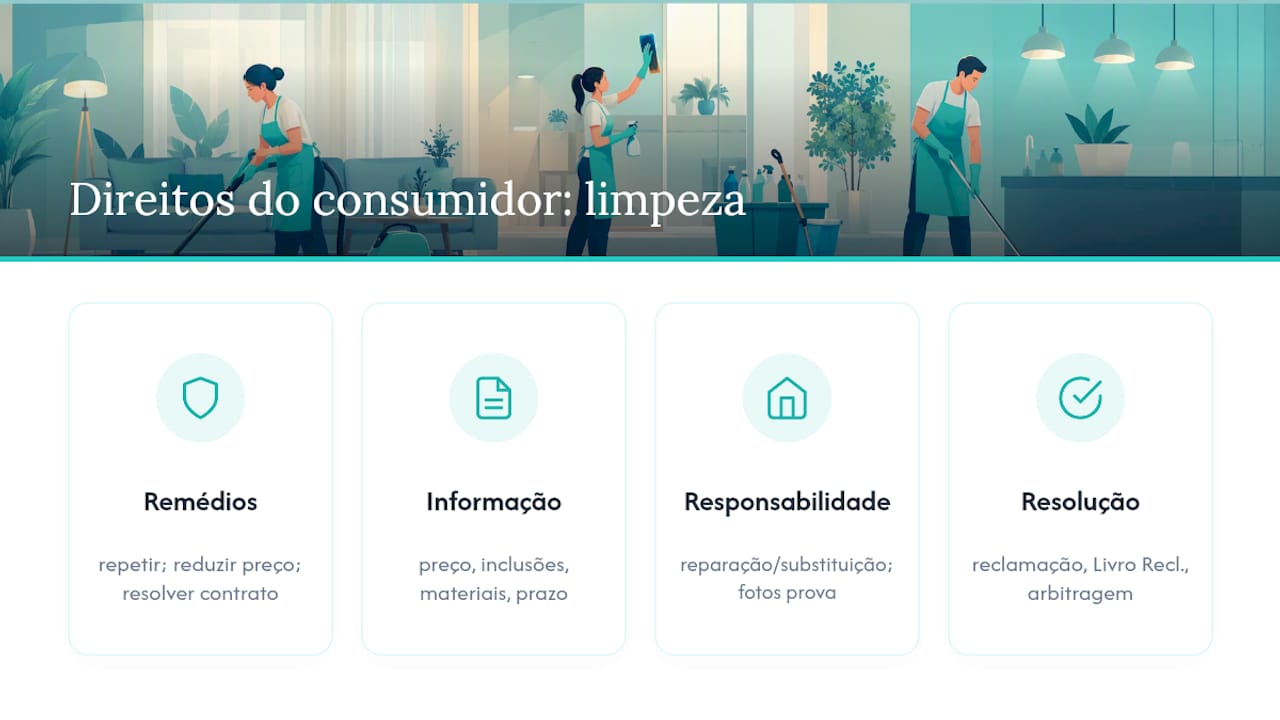
A cleaning service contract, even informal, creates concrete obligations for the provider. The company commits to performing the work as agreed, within the agreed timeframe and with the care expected from a professional. If the result is manifestly below what was contracted, you have the right to demand a repeat of the service, a price reduction, or, in serious cases, the termination of the contract.
The consumer also has the right to clear information before hiring: total price, what is included, materials used, and execution timeframe. If the company charges extras not previously agreed upon, or uses different products than those agreed without notice, this constitutes a breach of contract.
There is also the issue of liability for damages. If the cleaning team damages an object, a floor, or an appliance during the service, the provider is responsible for repair or replacement, regardless of whether they have their own insurance. Keeping photographs of the state of the house before and after the visit helps prove this type of damage, especially in post-construction cleanings or when tenants move out, where there are more objects and surfaces at risk.
None of these rights require legal proceedings to be exercised. Most are resolved with a well-prepared complaint, either directly to the company, through the Complaints Book, or via an arbitration centre.
Common examples of problems that justify a complaint about cleaning service
Some reasons for complaints arise more frequently than others, and it is worth recognizing them to know if your case justifies proceeding formally.
The most common is simply incomplete work: rooms or agreed areas that were left uncleaned, such as the inside of the oven, skirting boards, or exterior windows. Next is the use of inappropriate products, which can damage surfaces (marble, treated wood, stainless steel) or leave visible residues.
It is also common to experience failure to show up without prior notice, especially in recurring services where the client organizes their schedule based on the scheduled visit. When this happens repeatedly, there is legitimate cause for complaint even without material damage.
Damages caused during the service, such as breaking decorative objects or scratching surfaces, justify immediate complaint, especially if the company does not take responsibility spontaneously. Finally, there are cases of improper charges: amounts different from the quoted price, unsolicited extras, or charging for travel not previously agreed upon.
In all these cases, the criterion for justifying a formal complaint is the same: the service provided does not correspond to what was agreed, and the company did not correct the situation when confronted directly.
Detailed steps to write an effective complaint
A well-written complaint clearly increases the chances of a favorable response, whether from the company or from an arbitration centre. The text should be objective, chronological, and without excessive emotional charge, even when frustration is understandable.
Start by identifying yourself and the company accurately: full name, date of service, amount paid, and payment method. Then, describe the facts in chronological order: what was contracted, what was actually delivered, and the difference between the two. Avoid vague adjectives like "terrible" or "unacceptable"; prefer concrete facts: "the oven was not cleaned despite being included in the quote" is more effective than "the service was a disaster".
Always include a clear request section: what you expect to happen next. It can be a partial refund, a repeat of the service, or repair of damage. A vague request makes it difficult for the other party to respond.
End by mentioning the attachments accompanying the complaint, invoice, photographs, exchanged messages, and the deadline you consider reasonable for a response. Always keep a copy of the final text, with the date of sending, before submitting it on any official platform.
Legal consequences for the company in case of non-compliance
Ignoring a complaint is not a cost-free option for the company. Non-compliance with the response deadline in the Complaints Book, 15 working days, can be reported to regulatory entities such as ASAE, which monitors compliance with the obligations associated with the complaints book and can impose sanctions on non-compliant companies.
When the case advances to an arbitration centre, the final decision has binding effect if both parties agree to submit to arbitration, and non-compliance with an arbitral decision can be enforced judicially, just like a common court ruling. This gives the consumer a real mechanism of pressure, without lawyer costs or the slowness of a court process.
There are also concrete reputational consequences. Complaints registered on public platforms without response become associated with the company's history, something that weighs increasingly on the decision of other consumers before hiring a cleaning service. For companies that rely on recommendations and local reputation, as is the case for most providers in Lisbon, this has a direct impact on business.
Editorial: what really separates a successful complaint from an archived one
Most guides on complaints treat the process as purely bureaucratic: fill out the form, wait for a response. This ignores what the data shows; archived processes almost always fail due to lack of instruction, not due to lack of consumer merit.
Conventional advice focuses too much on "knowing your rights" and too little on "documenting well". Being right is not enough if you do not have organized proof that you attempted to resolve the matter directly before escalating. Arbitration centres in Portugal clearly prioritize the amicable route first, and this is not useless bureaucracy: it is the filter that determines whether your process advances or gets stalled.
If there is a real priority in this matter, it is this: document everything from day one, even before deciding whether to complain. Dated photographs and an initial contact email are worth more than any well-constructed argument without support. This is also why providers with digital reports and written checklists make life so much easier for the consumer, even when a complaint never comes to exist.
— Taras
A cleaning service without surprises, in Lisbon
After going through this entire complaint process, deadlines, evidence, forms, perhaps the most practical conclusion is this: prevention is worth more than complaining. Cleaning Point operates with detailed checklists by room, fixed teams, and a digital report after each visit, which eliminates the ambiguity that is the source of most complaints against cleaning services in Lisbon.
If you are looking for regular maintenance, a deep clean, or preparing a house for new occupants, Cleaning Point serves families and owners throughout the Lisbon region, with multilingual support and access management included in the service. You can check the level of care suitable for your home and compare what is included in each type of visit before deciding.
The next step is simple: schedule a cleaning and experience a service where every task is recorded, leaving no room for doubt about what was or was not done.
Official links and forms you need to act
Keep these three resources before proceeding with any complaint:
- Electronic Complaints Book for direct submission against the company
- Form from the Directorate-General for Consumers for referral and support
- CNIACC to file a complaint with an arbitration centre
Sources
- Complaints Book
- DGC Support - Complaint
- Consumer dispute resolution (Gov.pt)
- CNIACC - National Centre for Information and Arbitration of Consumer Conflicts
Frequently asked questions
How to complain about an unsatisfactory cleaning service?
First, contact the company in writing and keep proof of that contact. If there is no satisfactory response, submit a complaint in the Complaints Book or resort to an arbitration centre through the CNIACC.
How to report a business for lack of hygiene?
Reports of lack of hygiene in commercial establishments should be directed to ASAE, which monitors safety and hygiene conditions and receives complaints through the respective official channel.
How to make an anonymous report for inspection?
Some regulatory entities, such as ASAE, accept reports without complete identification of the reporter, although formal complaints requesting resolution usually require identification to allow for a response.
How do I file a complaint as a consumer in general?
Use the Complaints Book, either physical or electronic, available at any economic operator, or resort to the DGC form for referral to an arbitration entity.
How long does it take to resolve a cleaning complaint through arbitration?
When the process is well-prepared with all documentation, resolution usually occurs within 90 days after the complete process is entered at the competent centre.
Does Cleaning Point handle complaints differently from other providers?
Cleaning Point uses detailed checklists and digital reports for each visit, which reduces ambiguity about the work performed and facilitates direct resolution of any issue before it becomes a formal complaint.


