Cleaning Report: The Complete Guide for Portugal

A cleaning report is the document that records what was cleaned, when, with which products, by whom, and with what result, serving as proof of execution and a quality control tool. Without it, there is no way to prove compliance with the client, with audits, or with the HACCP requirements applicable to food spaces.
A solid cleaning report always includes these elements:
- What was cleaned — area, equipment, or facility
- When — date, time, and frequency
- With what — product, dilution, and technical data sheet
- How — method, sequence, and equipment used
- Who — identification of the technician and signature or validation
- Evidence — dated photos and recorded non-conformities
- Consumption — quantity of material used
- Indicators — quality score and link to the SLA
The structure is not bureaucracy for bureaucracy's sake. It closely follows what the Hygiene Plan of ASAE requires for spaces with HACCP obligations, and the service level report model described in Annex 7 of ENCPE 2020. Companies that conduct serious monthly audits, like Cleaning Point, use practically the same fields.
Key Findings
A cleaning report only fulfills its function when it combines proof of execution, quantifiable data, and a clear action plan for each non-conformity.
| Point | Details |
|---|---|
| Minimum mandatory fields | Record what, when, with what, how, and who, following the ASAE model. |
| Attached technical sheets | Keep dilution and safety data sheet for each product used in HACCP area. |
| Indicators linked to SLA | Use a scale of 1 to 4 per area and aggregate monthly to adjust billing. |
| Non-conformities with deadlines | Record detection, responsible person, action, and deadline, with minutes within two business days. |
| Practical example in Lisbon | Cleaning Point delivers a digital report with dated photos and signed validation at each visit. |
Index
- How to make a cleaning report: field model and filling
- What checklists to use by type of space?
- What standards govern the cleaning report in Portugal?
- How to interpret the quality indicators of the report?
- How to record non-conformities and corrective actions?
- Example of a cleaning report applied to a real case
- Digital or paper report: which to choose?
- How Cleaning Point applies this in practice
- Sources
- Frequently asked questions
How to make a cleaning report: field model and filling
A functional cleaning report model is organized by facility or area, not by technician. Each line corresponds to a cleaned area on a specific date, with the identified service modality: regular, deep, or post-construction. Without this distinction, it is impossible to compare months or justify price variations.
The technical fields are the ones that most often lack in generic reports. It is not enough to write "multi-purpose disinfectant": it is necessary to indicate the applied dilution and refer to the product's technical data sheet, something that ASAE explicitly recommends for operations subject to HACCP. The method (friction, spraying, dragging) and the equipment used (microfiber, steam machine, industrial vacuum) complete the record.
| Field category | What it should contain |
|---|---|
| Identification | Facility, area, date, time, service modality |
| Product and technique | Product, dilution, technical sheet, method, equipment |
| Time control | Planned hours vs. executed hours |
| Consumption | Quantity of material used per visit |
| Validation | Technician's name, signature or digital validation |
| Attachments | Dated photos, safety data sheet, meeting minutes |
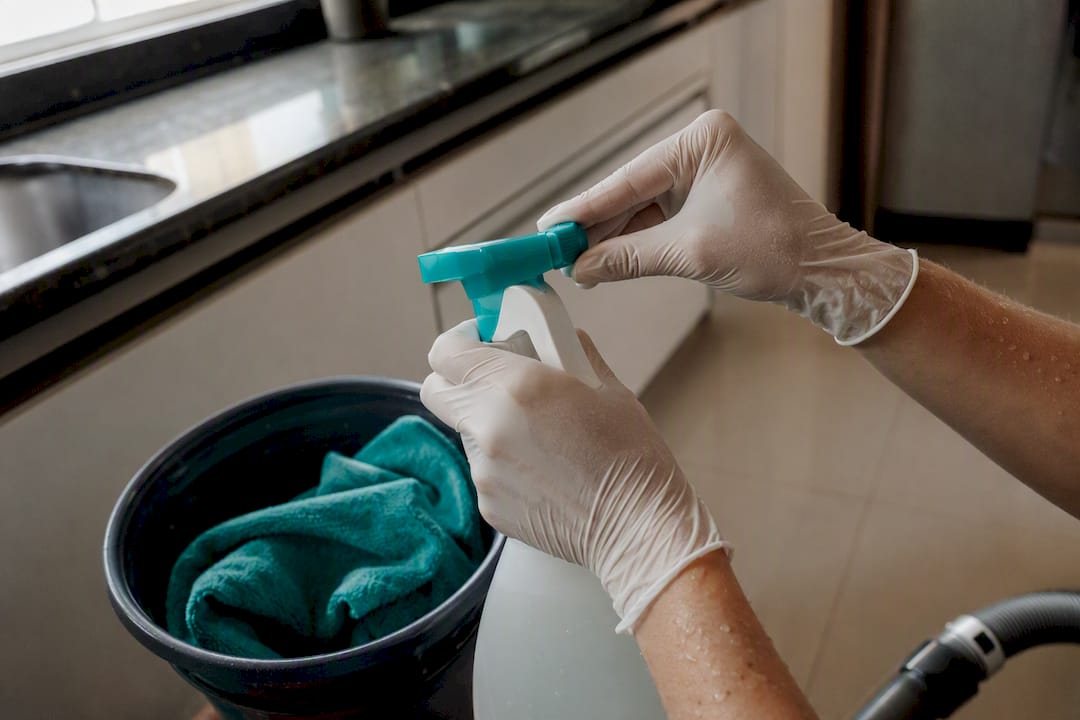
In digital format, each photo should include metadata with a timestamp and, ideally, geolocation. This transforms a loose image into forensic proof that the service occurred on that day and at that location, not a recycled photo from another visit.
What checklists to use by type of space?
Each type of facility has different critical points, and the cleaning checklist should reflect this instead of repeating a generic list.
In accommodation (residence, local accommodation), the central items are bedrooms, bathrooms, and common areas, always with a photo and validation signature at the end of the visit. In an office, the focus shifts to frequently contacted surfaces, kitchens, windows, waste management, and recording the consumption of consumables like toilet paper or soap. In a kitchen or food area, the checklist must follow HACCP logic: equipment, surfaces in direct contact with food, correct cleaning and sanitization sequence, and filing the safety data sheet of the product used. A post-construction requires debris removal, deep cleaning of dust on vertical and horizontal surfaces, checking coverings, and before-and-after photos.
Some items cannot simply remain "pending" in the report — they generate immediate non-conformity:
- Absence of technical data sheet for chemical product used in food area
- Surface in direct contact with food without complete sanitization
- Lack of signature or validation from the responsible person on-site
What standards govern the cleaning report in Portugal?
In spaces with food obligations, the cleaning report is not just a commercial document: it is part of the HACCP documentation required. The ASAE Hygiene Plan requires that each record answers five questions: what was cleaned, with what, when, how, and who performed the operation, always with a safety data sheet available for the chemical products used.
For public contracts or larger tenders, ENCPE 2020 recommends that bidders present a service level report, with a model exemplified in Annex 7, describing the methodological procedures used to control execution. Municipal specifications follow the same logic: an example from the Municipality of S. João da Madeira requires a monthly report per facility, with the hygiene plan posted and penalties provided for non-compliance.
Omitting the dilution of the disinfectant used, or not attaching the respective safety data sheet, can invalidate the compliance of the entire sanitization process in the face of an external audit.
In spaces without direct HACCP requirements, qualitative verification (visual inspection, signed checklist) usually suffices. Quantitative microbiological control is only justified in higher-risk clinical or food environments. It is also worth recording the minutes of the monthly meeting with the supervisor, with defined deadlines for submission.
How to interpret the quality indicators of the report?
A cleaning report without indicators is just a task list. The indicators that really matter are the coverage of the journey (visits completed vs. planned), the number of non-conformities per month, the average resolution time, and the rework rate.
- Journey coverage: percentage of visits completed as planned
- Non-conformities: monthly count by area and severity
- Average resolution time: days between detection and correction
- Rework rate: repeated visits due to failure in the previous one
- Material consumption: quantity used per m² or per visit
Professional tip: *Aggregate the score by area on a simple scale of 1 to 4 and calculate the monthly average.
The monthly audit roadmap organizes this information into four blocks: documentary, operational, perceived quality, and indicators, with SLA goals, such as a minimum coverage of 98% or a limit of calls per 1,000 m². Presenting this in a simple graph or summary table at the end of the monthly report facilitates reading for decision-makers.
How to record non-conformities and corrective actions?
A non-conformity without an action plan is just a recorded complaint. The correct flow follows six steps:
- Detection — who identified the problem and where
- Description — what is wrong, objectively
- Photographic evidence — dated photo of the problem
- Responsible — who is in charge of the correction
- Proposed action and deadline — what will be done and by when
- Status — open, in progress, or resolved
An example of a real entry: "Area: kitchen, floor 2. Problem: grease residue on stove plate. Responsible: technician A. Action: reinforcement of alkaline degreaser on the next visit. Deadline: 48 hours. Status: resolved."
Practical rules help maintain the pace: the minutes with the supervisor should be issued within two business days after detection, and recurring non-conformities in the same area (three or more times in the same month) should automatically escalate for review of the hygiene plan, not just for changing the professional in the field.
Example of a cleaning report applied to a real case
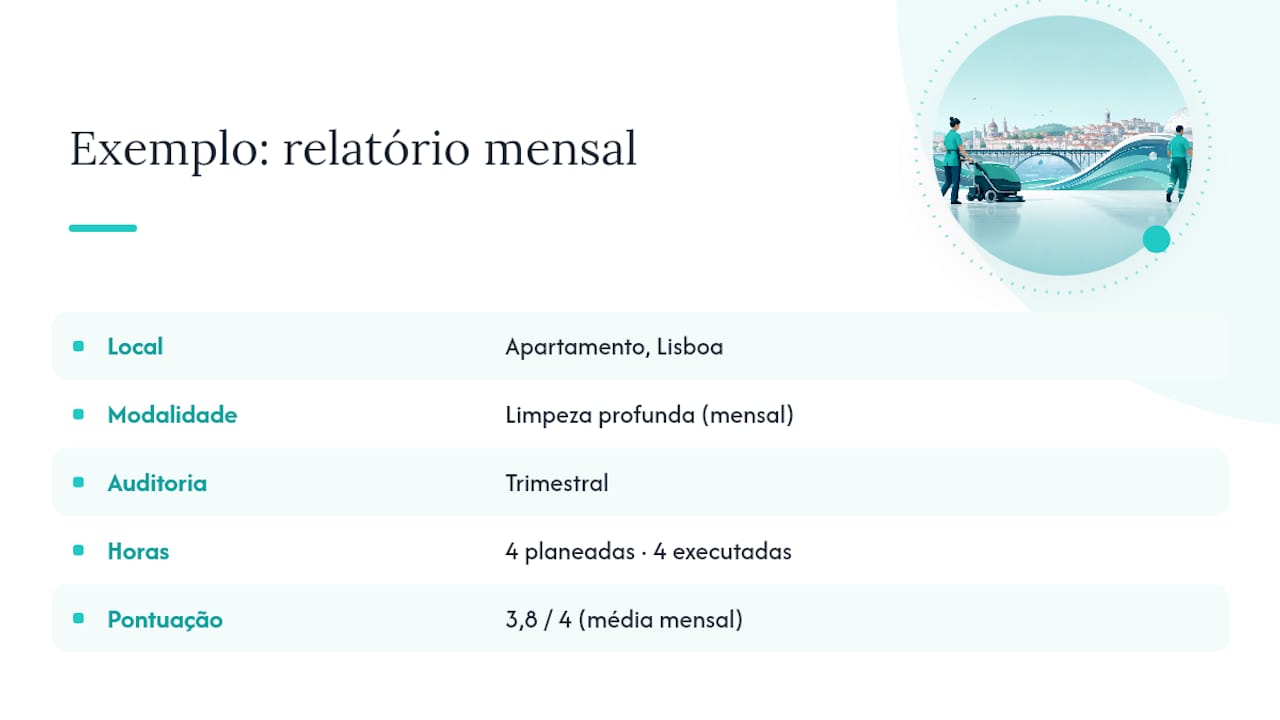
An example makes all this concrete. Consider a residential apartment in Lisbon with a monthly deep cleaning contract and quarterly audit.
This month's report identifies the facility, the date, and the modality (deep cleaning), lists the products used with dilution and technical data sheet, and records four hours executed against four planned. Two dated photos show the state of the kitchen before and after. The minutes of the meeting with the client point out a minor non-conformity: lime stains on the bathroom faucet, resolved in the next visit with a specific acidic product.
The average score for the month was 3.8 on a scale of 1 to 4. Without an applicable reducing factor, but recorded as a reference for the following month.
This type of documentation, with digital signature, timestamp on photos, and verifiable metadata, is exactly what Cleaning Point uses as a standard in its deep cleaning services in Lisbon. The report ceases to be paper stored in a drawer and becomes a decision-making tool.
Digital or paper report: which to choose?
The digital cleaning report has clear advantages over paper: automatic metadata in photos, quick search by date or area, and direct integration with management applications and ticket systems. The technology applied to validation greatly reduces the discussion about whether a visit occurred or not.
- Technician's signature and client or supervisor validation at the end of the visit
- Automatic date and time stamp on each photograph
- Active monthly archive and annual archive for historical consultation
Professional tip: Place a discreet QR Code at critical points (kitchen entrance, machine room) for the technician to validate passing through there with their mobile phone. This eliminates any doubt about the actual cleaning sequence.
The value of a well-made report
A well-structured cleaning report is not just for filing. It reduces uncertainty between client and provider because it replaces words with evidence. After years of seeing vague reports and detailed reports side by side, the difference is never in the amount of text: it is in what can be proven when something goes wrong. A monthly ritual of audit and review of the hygiene plan, with real data, is what separates suppliers who manage quality from those who merely clean.
How Cleaning Point applies this in practice
Cleaning Point is the alternative to improvising loose checklists or relying solely on the technician's word: each visit generates a digital report with dated photos, detailed checklist by division, and signed validation.
If you manage a property in Lisbon and want to stop wasting time reconstructing the cleaning history when a doubt arises, this is the moment to change systems. Cleaning Point's regular home care and deep cleaning services already include this documentation by default, with no extra cost for the report. For owners with secondary residences or rental apartments, the residence care combines the same audit logic with a schedule adapted to the property's occupancy. You can consult real examples in previous works or book a cleaning directly and see the first report at the next visit.
Sources
- Hygiene Plan — ASAE
- ENCPE 2020 — Criteria for ecological public procurement (Annex 7)
- Specifications — Provision of cleaning services (Municipality of S. João da Madeira)
- Monthly audit of the cleaning company: the roadmap — oHub Base Facilities
Frequently asked questions
What is a cleaning report?
It is the document that records what was cleaned, when, with which products, and by whom, serving as proof of execution and a basis for quality control.
What fields cannot be missing in a cleaning report?
Identification of the area, date and time, product and dilution used, method applied, responsible technician, and dated photographic evidence.
What is the difference between a weekly and a monthly cleaning report?
The weekly report focuses on the daily execution of tasks, while the monthly report aggregates indicators, scores, and serves as a basis for audit and billing adjustment.
Is the cleaning report mandatory by law in Portugal?
It is mandatory whenever there are applicable HACCP obligations, such as in food spaces, and is often required in public contracts and municipal specifications.
How does Cleaning Point document its cleanings?
Cleaning Point issues a digital report with a detailed checklist, dated photos, and signed validation at each visit, following the same monthly audit logic described in this guide.


