Cleaning for allergies: what to do in each room of the house

Avoid products with strong fragrances, concentrated bleach, and aerosols. These five actions concentrate most of the practical benefit against pollen, dust mites, and chemical irritants.
In summary:
- The use of well-maintained anti-dust mite covers and washing bedding at temperatures above 55 °C are essential to reduce the dust mite load in the bedroom.
- Vacuuming with a HEPA filter and steam cleaning, combined with good ventilation, help to reduce fine particles and prevent air recontamination.
- It is important to avoid products with strong fragrances, concentrated bleach, and aerosol sprays, opting for neutral detergents and certified products without irritating volatile compounds.
- Ventilating the space at the right times, controlling relative humidity between 40% and 50%, minimizes dust mite reproduction and fungus growth.
- When symptoms persist, hiring a professional cleaning service with anti-allergic equipment and checking the source of the reaction to chemical ingredients can be crucial for improving air quality.
Index
- Essential measures in the bedroom to reduce dust mites and household dust
- How to clean living room, bathroom, kitchen, and laundry to reduce allergies
- Which products to avoid and how to choose safe alternatives in Portugal
- Practical evaluation of HEPA vacuums, air purifiers, and steam cleaning
- How to manage humidity and ventilate strategically during pollen season
- When to hire a professional cleaning service and anti-allergic service checklist
- Dust mite control in sofas, carpets, and other less obvious areas
- Cleaning and care for pets to minimize allergies
- Identification and management of sensitivities to specific cleaning products
- Daily and weekly routines to keep the house with few allergens
- Cleaning Point's view on long-term anti-allergic maintenance
- Practical option: Cleaning Point services for clients with sensitivities
- Sources
- Frequently asked questions
Essential measures in the bedroom to reduce dust mites and household dust
The bedroom has the highest daily exposure to dust mites, as we spend several hours there, breathing close to the mattress and bedding. The SPAIC recommends focusing cleaning efforts here, with bedding washed at over 55 °C, anti-dust mite covers, and frequent vacuuming, emphasizing that measures work best when combined.
- Wash sheets, pillowcases, and blankets weekly at high temperatures, according to the manufacturer's instructions, to effectively eliminate dust mites, and dry well in the sun or in a hot cycle.
- Use anti-dust mite covers on the mattress, pillows, and duvets, choosing tightly woven fabrics instead of non-woven ones, which filter less.
- Reduce heavy textiles like thick curtains and carpets, and prefer washable flooring in the bedroom.
- Vacuum twice a week with a HEPA filter vacuum, including the mattress and the edges of the skirting boards.
The effectiveness of the covers also depends on maintenance: regular hot washes eliminate allergens more consistently than cold or sporadic washes, according to scientific reviews on environmental interventions in mite-associated asthma.
Professional tip: Those suffering from allergies should leave the room during vacuuming and only return after 15 to 20 minutes to allow the stirred particles to settle.
How to clean living room, bathroom, kitchen, and laundry to reduce allergies
Each room has a different risk: pollen in the living room, humidity in the bathroom, grease and steam in the kitchen. The approach changes in each space.
- In the living room, dust with a damp cloth instead of a duster, and vacuum upholstery with the appropriate nozzle, preferring removable and washable covers when the sofa allows.
- In the bathroom, ventilate immediately after showering and clean corners and skirting boards prone to mold, where humidity accumulates more quickly.
- In the kitchen, use the extractor whenever cooking and clean surfaces with a damp cloth to prevent grease vapors from settling in crevices.
- In the laundry, use hot cycles for bedding and duvets, and consider a professional washing service when the volumes are large or the textiles too heavy for the domestic machine.
The logic is common to all four rooms: remove humidity quickly and never raise dust dry, which only redistributes it in the air instead of removing it.
Which products to avoid and how to choose safe alternatives in Portugal
Concentrated bleach, ammonia, aerosol sprays, and heavily scented products are among the most common irritants in Portuguese homes, potentially worsening allergic rhinitis and asthma in sensitive individuals. The problem is not just the smell: certain volatile compounds irritate mucous membranes even in those without a diagnosed allergy.
The Regulation (EU) 2026/405 requires that detergent labels identify allergenic fragrances, preservatives, and enzymes, including substances like citronellol and linalool. This allows consumers to consciously avoid the most problematic products.
In practice, this means:
- Choose neutral and fragrance-free detergents, especially for bedding and towels.
- Prefer certified eco-friendly products, with a visible ingredient list on the label.
- Ventilate the room well during and after using any cleaning product, even the mildest ones.
- Always dilute as indicated, as concentrated products release more irritating vapors.
Practical evaluation of HEPA vacuums, air purifiers, and steam cleaning
Not all equipment sold as "anti-allergenic" has the same impact. Vacuums with HEPA filtration reduce the amount of fine particles that remain suspended in the air after vacuuming, but they only work well when bags or containers are well sealed and changed regularly.
- Prefer vacuums with certified HEPA filters and check that the container seal is effective, not just the filter.
- Remove and seal the bag outside whenever possible and ventilate the room for ten to twenty minutes after vacuuming, reducing exposure to re-suspended particles.
- Air purifiers with HEPA filters help in enclosed spaces, but do not replace natural ventilation of the house.
- Steam cleaning is useful on washable surfaces and some upholstery, but does not always eliminate deeply embedded dust mites in thick fabrics.
The positioning of the purifier also matters: placed in an isolated corner, it filters much less air than when it is close to the area where the person spends the most time, such as the bedroom.
Professional tip: Always combine HEPA vacuuming with regular ventilation. No isolated equipment solves the problem on its own.
How to manage humidity and ventilate strategically during pollen season
Maintaining relative humidity between 40% and 50% limits dust mite reproduction and fungus growth, a practical threshold referred to in reviews on environmental control of allergens. However, ventilation requires extra care during pollen season.
The DGS recommends ventilating daily for at least ten minutes, adjusting the timing to the pollen concentration in your area:
- Ventilate early in the morning or late in the day, avoiding peak pollen concentration hours.
- Close windows during pollen peaks, especially on dry and windy days in spring.
- Use mechanical extraction in the kitchen and bathroom to remove humidity without needing to open windows at those times.
- Consider pollen screens or filters on bedroom windows, where nighttime exposure is prolonged.
This combination of timing and mechanical extraction adapts well to Portugal's maritime temperate climate, where humidity varies significantly between seasons.
When to hire a professional cleaning service and anti-allergic service checklist
There are clear signs that the domestic routine is no longer sufficient. Persistent symptoms despite all measures, recent renovations with accumulated dust, extensive mold on walls or ceilings, or physical inability to vacuum and wash regularly justify seeking professional support.
- Check if the service washes textiles at high temperatures, capable of eliminating dust mites more effectively than occasional domestic washing.
- Confirm that they use HEPA filter vacuuming on all surfaces, not just visible floors.
- Request controlled steam cleaning for upholstery and mattresses, when applicable to the type of fabric.
- Demand a report or checklist of the work done, to track what has been effectively treated.
Regular contracts tend to keep allergen levels more stable between visits than isolated one-off cleanings, as they prevent accumulation between visits.
Dust mite control in sofas, carpets, and other less obvious areas
The bedroom receives the most attention, but sofas, carpets, and rugs silently accumulate dust mites, especially in thick fabrics where humidity and shed skin cells accumulate for months. These surfaces are rarely washed as frequently as bedding, making them persistent reservoirs of allergens.
Vacuum sofas and carpets weekly with the appropriate upholstery nozzle, insisting on seams and under cushions. In high-pile carpets, vacuum in multiple directions to lift particles trapped at the base of the fibers. When the sofa fabric allows, prefer removable covers that can be washed at high temperatures, replicating the logic you already apply to bedding.
!
Wall-to-wall carpets are particularly difficult to keep free of dust mites, as deep cleaning requires equipment that most homes do not have. In these cases, periodic steam cleaning, done with appropriate equipment, helps reduce the allergen load, although it does not always eliminate dust mites embedded in the deeper layers of the fiber. Replacing carpets with washable flooring in high-traffic areas remains the most effective long-term measure.
Cleaning and care for pets to minimize allergies
Pets bring pollen stuck to their fur into the house, as well as pet dander that acts as an allergen in its own right. This does not mean giving up the pet, but adjusting the cleaning routine around it.
Brush the pet regularly in an easy-to-clean space, ideally outside the bedroom, and wash the pet's bed or blanket as frequently as human bedding. Wipe the pet's paws with a damp cloth after walks on days of higher pollen concentration, reducing the amount of pollen that enters the house stuck to their fur.
!
Keep the pet out of the bedroom whenever possible, especially if the allergic person sleeps there, and vacuum with a HEPA filter the sofas and carpets where the pet usually rests. The combination of frequent brushing, washing the pet's bed, and restricting access to certain rooms significantly reduces the amount of pet dander in circulation, without requiring drastic measures.
Identification and management of sensitivities to specific cleaning products
Not every reaction during cleaning is an allergy to pollen or dust mites: many people react directly to ingredients in the products themselves, especially bleach, ammonia, and synthetic fragrances. Distinguishing between the two situations helps to act more effectively.
If symptoms appear mainly during or immediately after using a specific product, such as coughing, burning eyes, or headaches, it is likely that the cause is the product itself and not dust or pollen. In that case, the simplest step is to read the label: Regulation (EU) 2026/405 requires the listing of allergenic fragrances, which allows identifying and avoiding the exact compound that triggers the reaction.
It is worth testing fragrance-free products for a few weeks and noting if symptoms decrease. When the reaction is intense even with mild products, ventilating more and reducing the concentration used helps, but if discomfort persists, evaluation by a doctor can confirm whether there is specific chemical sensitivity rather than general respiratory allergy.
Daily and weekly routines to keep the house with few allergens
Keeping allergens under control depends more on consistency than on the intensity of an isolated cleaning. A simple daily routine, ventilating for ten minutes at the right time, cleaning surfaces with a damp cloth, and airing the bathroom after showering, prevents pollen and humidity from accumulating.
Weekly, wash sheets at 60°C or higher, vacuum the bedroom, living room, and sofas with a HEPA filter, and check corners prone to mold in the kitchen and bathroom. Experts warn that isolated products, such as an air purifier or an anti-dust mite spray, rarely solve the problem on their own: an integrated routine, maintained over time, has more impact than any one-off product.
Also, set aside a moment monthly for less frequent tasks, such as washing curtains, changing vacuum filters, and checking window seals against pollen entry. This daily, weekly, and monthly structure transforms anti-allergic cleaning into a predictable routine rather than a one-off effort whenever symptoms worsen.
Cleaning Point's view on long-term anti-allergic maintenance
Reducing allergens is not a one-off cleaning; it is ongoing maintenance. This logic led us to structure the services of Cleaning Point with detailed checklists and teams that follow the same standards on each visit, from regular maintenance to deep cleanings and post-renovation, preparing homes for new occupants in Lisbon.
Consistency matters more than the intensity of a single visit: a house kept under control with regular visits accumulates less pollen, dust, and humidity than a house cleaned only when symptoms have already worsened.
— Taras
Practical option: Cleaning Point services for clients with sensitivities
If you are already applying the measures described and symptoms persist, the next step is to delegate the most demanding part of the routine to those who execute it with guaranteed regularity. Cleaning Point provides services in Lisbon designed exactly for this: fixed teams whenever possible, transparent checklists, and support in multiple languages, so that the cleaning standard does not depend on who shows up that day.
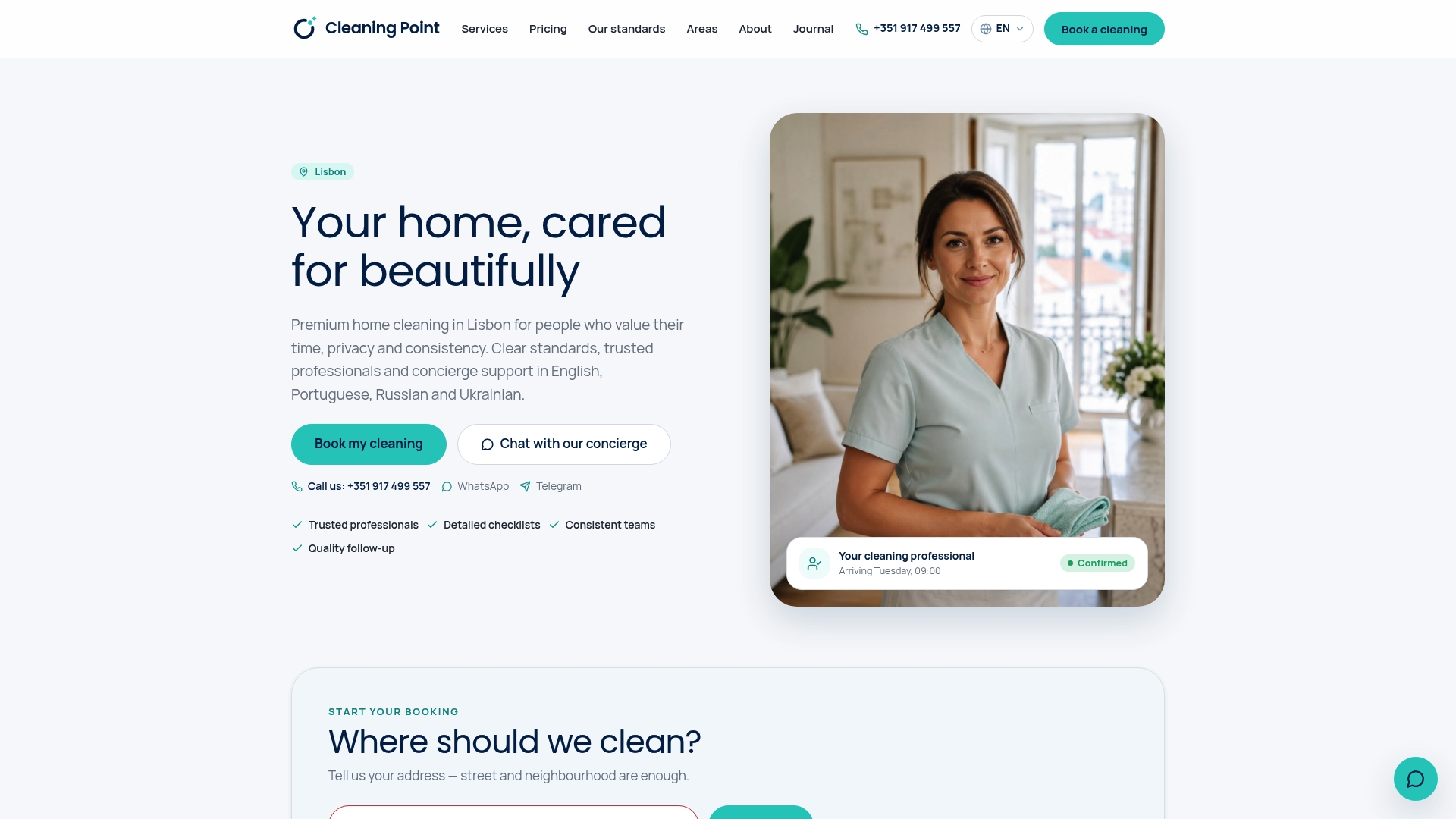
Among the most relevant services for those dealing with sensitivities are:
- Deep cleaning to remove accumulated dust and allergens deeply.
- Washing heavy textiles through regular maintenance, with cycles and frequency adjusted to the home.
- Post-renovation cleaning to eliminate fine construction dust that worsens respiratory symptoms.
Regular contracts keep allergen levels stable between visits. You can check the available services and schedule an assessment directly through the Cleaning Point website.
Sources
For those who want to delve deeper, the DGS gathers general recommendations on ventilation and indoor air quality, while SPAIC details specific eviction measures for dust mites in the bedroom. The Portuguese multicentric study of 2026 shows how sensitization to dust mites and pollen varies by region of the country.
This article provides general information and does not replace the advice of a qualified physician. Consult a qualified healthcare professional about your case before acting based on this content.
- DGS – General recommendations (indoor air)
- Regulation (EU) 2026/405
- Environmental interventions for mite-induced asthma (review)
- SPAIC — frequently asked questions / eviction measures
Frequently asked questions
What antihistamines are available in Portugal?
Oral antihistamines and nasal corticosteroids are the most common options for controlling allergic rhinitis symptoms, available at pharmacies with or without a prescription depending on the substance. The choice of product and dose should be made with a doctor or pharmacist, as it depends on the type of allergy and other health conditions.
How much does a cleaning company charge?
The price varies depending on the type of service, the area of the house, and the frequency contracted, with no fixed amount applicable to all cases. Cleaning Point provides personalized quotes based on the chosen service, from regular maintenance to deep cleanings.
What does a deep cleaning include?
A deep cleaning typically covers areas that regular maintenance does not address as frequently, such as the inside of cabinets, appliances, skirting boards, and corners prone to dust accumulation. It serves as a solid foundation before applying a weekly anti-allergic routine, especially after renovations or long periods without deep cleaning.
What are the symptoms of bleach allergy?
Exposure to bleach can cause coughing, burning eyes, nasal irritation, and headaches, especially in poorly ventilated spaces or when mixed with other products. Those who suffer from these symptoms recurrently should avoid concentrated bleach, always ventilate during use, and opt for fragrance-free alternatives, as indicated on labels under Regulation (EU) 2026/405.


